CGTN: Why China has become a hot summer destination

BEIJING, July 28 (Bernama-GLOBE NEWSWIRE) — CGTN published an article exploring the China Travel boom. As a growing number of global travelers head to China in search of cooler destinations, the article explores the country’s boom in inbound tourism this summer, and highlights how China’s expanding visa facilitation policies and foreigner-friendly services are driving this travel trend.

As extreme heat grips much of Europe, a new travel trend is taking shape. Increasingly, travelers are looking beyond their own borders in search of cooler summer destinations, and China is emerging as one of their top choices.

With its cool climate and picturesque landscape of green hills and clear waters, Liupanshui City, known as China’s “cool city” in southwest China’s Guizhou Province, has emerged as a favored destination for foreign travelers escaping the heat. During this summer vacation, more than 20 themed events, including music festivals and rural garden fairs, are taking place across the city, drawing visitors from around the world.

Touring the city this summer, Max Slonim, an American tourist, was impressed by the cool and comfortable weather. “Whenever you go to scenic and beautiful places, you can really experience nature and the peaceful atmosphere without huge crowds and long queues,” he said.

The broader momentum behind “China Travel” continues to build. During the first half of 2026, China recorded more than 22.91 million inbound visits, up 20.4% year on year. Traditional summer destinations such as Yunnan, Guizhou and Hunan provinces have topped international travelers’ summer wishlists.

Booming China Travel

In Zhangjiajie, a tourist city in central China’s Hunan Province known worldwide for its dreamlike landscape, the peak season for inbound visitors has arrived. Tourists from Europe, Southeast Asia and beyond venture into its UNESCO-listed sandstone mountains, where cool breezes and lush forests offer a natural retreat.

Benefiting from China’s 240-hour visa-free transit policy, the city has opened over 10 passenger air routes linking eight countries and regions. Fast-track immigration procedures and entry to major attractions with just a passport have made traveling in the city more seamless than ever for international visitors.

Since the beginning of July, family summer trips to the Zhangjiajie Grand Canyon Scenic Area have surged, with daily visits approaching 10,000 and inbound tourists accounting for over 50% of the total.

China’s cooler coastal destinations are also seeing rising popularity. Qinhuangdao, a seaside city in north China’s Hebei Province, has introduced a diverse lineup of summer activities, including sailing, speedboat rides, intangible cultural heritage performances and immersive VR experiences at the Great Wall Museum.

The city received 43,000 inbound visits during the first half of this year, up 50% year on year, while the average stay of overseas tourists doubled from seven days to fifteen.

The trend is especially noticeable among European travelers. European countries account for nearly 30% of China’s top 20 inbound source markets for this summer. Travel bookings have surged 275% year on year, while attraction ticket orders have increased by 20 times. Visitors from Britain, France and Germany alone account for nearly 42% of all European arrivals.

Why China?

Behind the tourism boom is China’s steadily expanding visa facilitation policy. China currently offers unilateral visa-free entry to nationals of 50 countries and has signed mutual visa exemption agreements with 29 countries. Meanwhile, nationals from 55 countries can now utilize the 240-hour visa-free transit program to enter China via 65 designated ports.

International accessibility has also improved significantly. Direct flights now connect overseas destinations with 160 Chinese cities, while more than three-quarters of inbound travelers now enter the country visa-free.

Meanwhile, travel services have become increasingly foreigner-friendly. Multilingual ticketing machines, AI-powered translation devices and customer support in English, French, Spanish and other languages are now widely available at tourist attractions and on major travel platforms.

Yet one detail repeatedly highlighted by foreign visitors is surprisingly simple: air conditioning. From airports and subway stations to shopping malls, hotels and tourist attractions, reliable cooling has become an essential part of China’s summer travel experience, supported by one of the world’s largest and most reliable power systems.

Across social media, videos of foreign travelers sharing their summer adventures in China have become windows through which global audiences are rediscovering the country. Increasingly, visitors are venturing beyond Beijing, Shanghai, Guangzhou and Shenzhen to explore ancient towns, mountain villages and lesser-known cities. What they are finding is more than just a cool place to escape the summer heat – they are discovering a China that is increasingly accessible, welcoming and vibrant.

CGTN
Digital cgtn@cgtn.com

SOURCE: China Global Television Network Corporation

Ancient Port, New Voyages: Ningbo’s Smart Manufacturing Expands Global Trade Footprint via Maritime Silk Road

NINGBO, China, July 7, 2026 /Xinhua-AsiaNet/–

On July 4, 2026, the cultural exchange event Encounter & Insight: Dialogue Between Ningbo, China and Colombo, Sri Lanka  took place in Colombo. 

Separated by thousands of miles, the two millennia-old port cities reconnected, leveraging their ports as a bond and cultural exchanges as a cohesive force to hold in-depth talks on integrated port-city development and bilateral economic and trade connectivity.

This cross-Indian Ocean dialogue echoes the ancient Maritime Silk Road while charting a brand-new outbound development path. As a pivotal starting port of the ancient Maritime Silk Road, Ningbo is building a new global trade landscape powered by smart manufacturing.

A thousand years ago, merchant vessels from Mingzhou Port set sail southward loaded with Yue Kiln celadon porcelain, passing through Ceylon to deliver Oriental crafts across the Indian Ocean coasts. Precious gemstones and spices traveled the same sea route back to regions south of the Yangtze River, laying the groundwork for the earliest cultural exchange between the two ports through trade. Today, the cargo carried by giant cargo ships has undergone a dramatic transformation. Beyond traditional daily necessities, intelligent equipment, digital home appliances and industrial robots now dominate shipments.

Official statistics show that Ningbo’s exports of intelligent equipment, including mechanical arms and industrial robots, hit 440 million yuan in 2025, surging more than 40% year-on-year. From January to May this year, Ningbo’s exports of mechanical and electrical products maintained steady growth, reaching 247 billion yuan, a 4.1% year-on-year increase and accounting for 58.0% of the city’s total export volume. The new energy foreign trade sector saw explosive growth, with exports of new energy vehicles, lithium batteries, and photovoltaic products jumping 138.4% year-on-year, with electric vehicle exports skyrocketing 215.9%. Smart manufactured goods are continuously expanding the scope of Ningbo’s foreign trade.

Complementing the Colombo forum, an exhibition highlights Ningbo’s outstanding going-global enterprises and their products, vividly illustrating the profound shift in Ningbo’s trade structure.

Alongside time-honored Maritime Silk Road staples such as celadon porcelain and silk, Ningbo’s smart manufactured products – including AI translation glasses, intelligent outdoor gear and digital small home appliances – occupy prominent display spaces across the venue. In Sri Lanka, Ningbo smart water meters are widely adopted nationwide, while handheld cooling fans and intelligent kitchen appliances have entered ordinary households.

Leveraging Colombo Port’s transshipment advantages, massive volumes of Ningbo smart manufactured goods are distributed onward to Europe, the Middle East and beyond. What Ningbo exports today is no longer mere commodities, but a complete outbound solution integrating technology, brand value and after-sales services.

Faced with mounting challenges including homogeneous global market competition and rising trade barriers, Ningbo’s manufacturing sector has abandoned the old model of low-cost OEM production, relying on intelligent transformation to consolidate its competitive edge in overseas markets.

Over more than a decade of digital transformation efforts, Ningbo has achieved full digital upgrading of all industrial enterprises above designated size. A large number of local factories have built unmanned black-light workshops and flexible production lines, escaping vicious price competition through continuous technological iteration. Represented by five specialized, sophisticated, distinctive and innovative enterprises dubbed Ningbo’s “Five Little Tigers” – famous for their core proprietary technologies, including highly sophisticated visual inspection equipment, heat-resistant materials, sun-proof coatings, puncture-proof materials and self-drilling fasteners – these niche manufacturers have developed differentiated technical routes and full-spectrum production capacity, cementing irreplaceable competitiveness for Ningbo smart manufacturing on global markets.

Beyond trade expansion, Ningbo has built a supporting cultural communication system to ensure “products go global, accompanied by local culture”.

The launch of Sri Lanka’s first “One-Meter Cultural Space” cultural station during the Colombo event marks a tangible milestone of Ningbo’s go-global initiative. Built on enterprises’ overseas outlets, these miniature cultural exhibition halls integrate intangible cultural heritage crafts, urban stories and smart products, enabling overseas clients to experience cutting-edge manufacturing while gaining insight into Ningbo’s profound cultural heritage.

During the twin-city story-sharing session, Ningbo entrepreneurs based in Sri Lanka and local designers blending Chinese and Sri Lankan aesthetics shared stories of bilateral exchanges. Economic and trade ties have evolved into a bond for people-to-people communication, bridging divides in cross-cultural trade.

From Tang-dynasty celadon porcelain sailing across the Indian Ocean to intelligent equipment shipping to every corner of the globe, Ningbo, the ancient Maritime Silk Road port, has preserved its enduring gene of openness. Where exchanges once relied purely on commodity trade, today smart manufacturing underpins a stable, diversified and high-value-added global trade network.

The Ningbo-Colombo dialogue stands as a vivid microcosm of this transformation: the port still links lands and seas, yet the core of its trade has undergone a full intelligent upgrade.

Rooted in its historical legacy as a key Maritime Silk Road hub, Ningbo has consolidated its industrial foundation through a decade of digital development, expanded global market reach via worldwide port networks, and softened trade cooperation through cultural exchanges. This brand-new outbound shipping route forged by smart manufacturing has not only reshaped the city’s foreign trade landscape, but also delivered a replicable port-city development model for Chinese manufacturing to go global.

Source: Ningbo International Communication Center

SINGAPORE’S TOP 100 BRANDS RISE 7 PCT TO US$84.1 BLN VALUE IN 2026

KUALA LUMPUR, April 28 (Bernama) — Singapore’s top 100 brands rose seven per cent year-on-year to a combined value of US$84.1 billion in 2026, driven by growth across the banking, engineering, food and real estate sectors, according to the Brand Finance Singapore 100 2026 report. (US$1 = RM3.95)

DBS Bank retained its position as Singapore’s most valuable brand for the 14th consecutive year, with brand value rising eight per cent to US$18.6 billion, supported by regional expansion and diversification efforts.

Marina Bay Sands ranked second in brand value at US$8 billion, rising 35 per cent, supported by strong revenue performance and ongoing upgrade investments that enhanced its premium positioning in the tourism sector, while OCBC Bank ranked third at US$6.8 billion, reflecting steady performance in wealth management and regional expansion initiatives.

The report highlighted strong performance across sectors, with engineering benefiting from aerospace and defence demand, food and agriculture supported by commodity trends, and real estate remaining stable on steady transaction activity, according to a statement.

Meanwhile, Changi Airport was named Singapore’s strongest brand, with a Brand Strength Index score of 91.2 out of 100 and an AAA+ rating, driven by record passenger traffic, expanded connectivity and continued service investment.

TeleChoice International was the fastest-growing brand in the ranking, with brand value surging 288 per cent to US$52.7 million, driven by strong demand in semiconductor-related segments and product expansion.

Millennium Hotels and Resorts was the top hotel brand, ranking 27th overall, supported by digital transformation initiatives, loyalty programme growth and expansion of its global property portfolio.

Separately, Singapore Airlines led sustainability perceptions among Singaporean respondents, particularly for its decarbonisation strategy, including its net zero emissions target by 2050 and investment in sustainable aviation fuel.

Other brands showing strong sustainability perceptions included Ascott and Banyan Tree for environmental sustainability, CapitaLand, Singapore Land and FairPrice in social sustainability, and DBS in governance, reflecting strong domestic recognition across environmental, social, and governance (ESG) pillars.

— BERNAMA

Kao’s Laurier Launches New Brand Communication Initiative across Asia: Strengthening Global Integration as a Core Brand in Kao’s Asian Business

Laurier Campaign Key Visual

TOKYO, March 4 (Bernama-BUSINESS WIRE) — Starting on International Women’s Day, March 8, Kao Corporation (TOKYO:4452) will launch new brand communication campaign in nine Asian countries and regions for its feminine sanitary product brand, Laurier, which is the core of its Asian business.

This press release features multimedia. View the full release here: https://www.businesswire.com/news/home/20260303996141/en/

Laurier aims to help create more supportive and understanding environments around menstruation, so that women can feel more at ease, both physically and emotionally, under the key message “Comfort, Made Together,” which will be implemented simultaneously across Asia. Kao aims to further develop Laurier as a global brand.

Laurier, one of the core brands supporting Kao’s consumer care business in Asia, has been promoting globally integrated operations since 2023. Across all nine Asian countries and regions including Japan, Laurier has been working to unify product specifications and consolidate production sites to improve asset turnover ratio. Moreover, Laurier has promoted discussions to unify interpretations of the brand purpose and worldview, which varied across regions, and has renewed the global guidelines.

Through these efforts, in order to simultaneously communicate its value throughout Asia, Laurier is currently initiating a new brand communication initiative. By returning to Kao’s founding principle of a consumer perspective, Laurier will further strengthen brand equity by offering products designed for long-term use and advancing empathy-driven marketing through consistent communication across regions.

Laurier conducted a survey on attitudes toward menstruation among 4,500 women across nine Asian countries and regions.* The findings revealed that across Asia, many women feel that menstrual symptoms, concerns, and the limitations associated with menstruation have an impact on their overall sense of comfort in daily life.
*An online survey on attitudes toward menstruation was conducted by Kao among women aged 15–44 in nine Asian countries and regions, including Japan, in November–December 2023 and October–November 2024 (valid responses: 4,500).

Through this initiative, Laurier will further its efforts toward creating an inclusive environment where women can live lives full of possibilities without feeling restricted by their periods.
As a global brand, Laurier not only provides products but also supports women throughout their lives by providing information and educational support, contributing to the creation of a society where each woman can continue to live in a way that feels true to herself.

About the Brand Communication Initiative

– Key Message
Comfort, Made Together ―Laurier is here to listen.
It’s natural to find it difficult to be your normal self while you’re on your period. A woman shouldn’t have to find menstrual comfort on her own. We may not be able to completely eliminate physical discomfort or pain. But by encouraging understanding from those around us and shaping more supportive environments, we believe periods can feel a little more comfortable.
– Overview
This campaign will unify the brand’s worldview across nine Asian countries and regions, and will implement the following initiatives:

  • Development of a common key visual and message across Asia
  • Release of anthem films (9 country/regional versions) conveying Laurier’s message of menstrual support
  • Launch of a special campaign website

– Countries/Regions: Kao Corporation / Kao Commercial (Shanghai) Co., Ltd. / Kao (Hong Kong) Ltd. / Kao (Taiwan) Corporation / Kao Vietnam Co., Ltd. / Kao Industrial (Thailand) Co., Ltd. / Kao (Malaysia) Sdn. Bhd. / Kao Singapore Pte. Ltd. / PT Kao Indonesia
– Start Date: March 4, 2026

Ongoing Social Initiatives

As a brand that supports women, Laurier is continuously engaged in the following activities in each country and region.

  • Japan: “Laurier in Workplace” and “Laurier in School,” making sanitary napkins available as standard supplies at workplaces and schools
  • Indonesia: “Dr. Laurier,” providing expert knowledge on menstrual concerns that are hard to discuss with others

In addition to the above, Laurier provides menarche education to deliver accurate knowledge to individual in all nine countries and regions. Through these activities, Laurier will continue to be more than just a feminine sanitary product brand; it will continue to be a presence that supports women at all stages of their lives and in their social environments.

Comment from Kazuya Miyashita, President of the Sanitary Business, Kao Corporation

Laurier has been striving to strengthen its globally integrated operations. The launch of this new brand communication across nine Asian countries and regions marks the next stage in building a consistent global brand―one that transcends borders, listens to the voices of individual, and shares Laurier’s vision and values across Asia. While menstrual concerns and feelings vary from person to person, there are many aspects of menstruation that have been discussed as something to be endured or a personal issue. Through this communication campaign, Laurier aims to elevate menstrual concerns beyond a personal issue, encourage understanding from others, and foster an environment in which women can live with greater peace of mind. As a core brand in Kao’s Asian business, Laurier will continue to contribute to sustainable growth and the realization of a society where women can live their lives with comfort, confidence, and fewer limitations—no matter the day.

About Kao

Kao, a Japan-based manufacturer of personal care and household products, cosmetics, and specialty chemicals creates high-value-added products and services that provide care and enrichment for the life of all people and the planet. Through its brands such as Attack laundry detergent, Bioré and Jergens skin care products, Laurier sanitary products, Curél, SENSAI, and MOLTON BROWN cosmetics, and Oribe hair care products, Kao is part of the everyday lives of people across Asia, the Americas, Europe, the Middle East, and Africa. Combined with its chemical business, which contributes to a wide range of industries, Kao generates about 1,630 billion yen in annual sales. Kao employs about 32,600 people worldwide and has more than 130 years of history in innovation. As an enterprise that provides products people use on a daily basis, the Kao Group takes responsibility to actively reduce the environmental footprint of its products throughout the product lifecycle. This is laid out in Kao’s ESG strategy, the Kirei Lifestyle Plan, which launched in 2019.
Please visit the Kao Group website for additional information.

View source version on businesswire.com: 
https://www.businesswire.com/news/home/20260303996141/en/

Contact

Media inquiries should be directed to:
Public Relations
Kao Corporation
corporate_pr@kao.com

Source : Kao Corporation

Shanghai records growing tourist arrivals, spending during Spring Festival holiday

During the Spring Festival holiday, Shanghai launched more than 2,570 featured cultural and tourism activities.

SHANGHAI, Feb. 26, 2026 /Xinhua-AsiaNet/–

During the nine-day Year of the Horse Spring Festival holiday, Shanghai launched more than 2,570 featured cultural and tourism activities to promote travel to the bustling city, fueling a robust boom in Spring Festival cultural and tourism consumption as both visitor numbers and consumption in the cultural and tourism market saw steady growth.

Big data from Shanghai Municipal Administration of Culture and Tourism shows the city received a total of 21.6721 million visitor arrivals, an 8.36% year-on-year increase. Total tourism consumption reached 25.614 billion yuan, surging 20.90% from the previous year.

The average room occupancy rate of local hotels and guesthouses rose to 50.60%, up 3.10 percentage points year-on-year.

The promotion campaign leveraged the outcomes of the first high-level competition to introduce Shanghai’s tourism and integrated the city’s cultural, tourism, commerce, sports and exhibition resources.

Product innovation and transformation drove Shanghai’s Spring Festival cultural and tourism development this year, spawning a new trend of spending the Chinese New Year in the city.

Shanghai’s cultural and tourism authorities rolled out over 130 in-depth Spring Festival tour routes under three themes, which became bestsellers on OTAs via live-stream sales on major platforms. Inbound tourists from niche markets like Greece and Slovenia doubled, experiencing the unique charm of Jiangnan and Shanghai culture immersively.

Shanghai also created premium IPs such as the themed tour routes. With joint efforts of multiple departments, 353 themed activities were launched on the “Hu Xiaoyou” smart travel service platform. At the same time, science popularization and industrial tourism also gained traction, making Shanghai the top choice for enjoying the Spring Festival elsewhere besides the hometown.

Key cultural and commercial landmarks, including West Bund GATE M, Panlong Ancient Town and Zhangyuan Garden, held Spring Festival fairs and garden parties, creating new urban Chinese New Year rituals. For the first time, Shanghai hosted large-scale concerts during the holiday, with Richie Jen’s and Capper’s concerts drawing numerous fans from across the country.

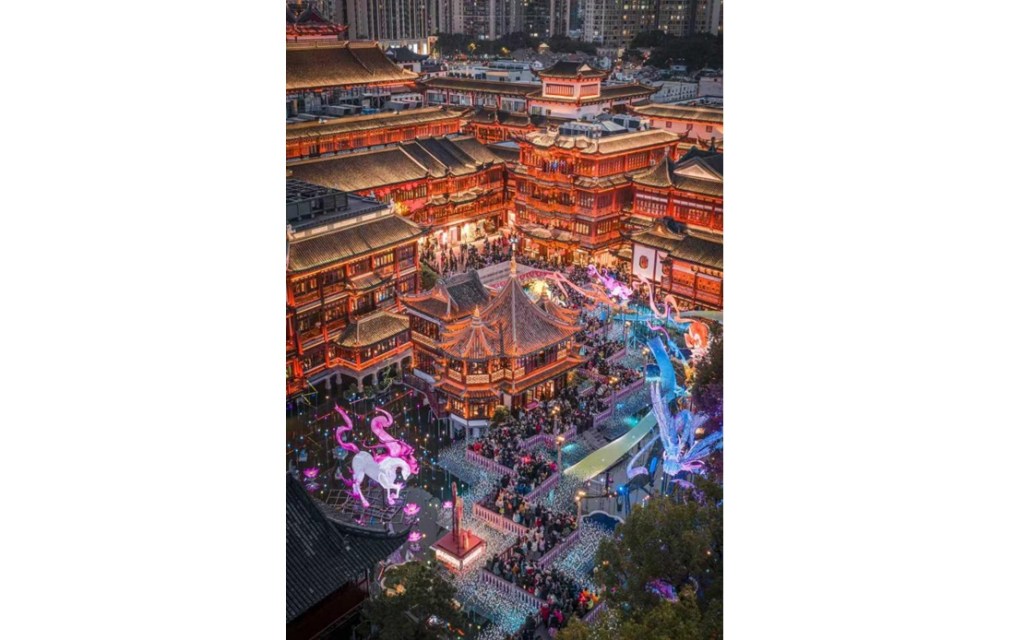
The blend of Shanghai-style Chinese New Year vibes and trendy Chinese cultural elements boosted the festive folk atmosphere in the city. Centering on experiencing the vibe of ordinary life, Shanghai launched a city-wide lantern show campaign. The lantern shows at Yuyuan Garden and the Inlet lit up the city’s nights with stunning light displays.

Intangible cultural heritage fairs and master chefs’ kitchens were set up in urban cultural and tourism complexes and suburban ancient towns. Some high-end hotels have integrated intangible cultural heritage into one-stop stays that integrate accommodation, dining, and travel experiences. Local traditional delicacies such as Shanghai cuisine and Nanxiang steamed buns offered visitors authentic Chinese New Year flavors.

Looking forward, Shanghai will further integrate cultural and tourism resources, pursue continuous product innovation, boost the upgrading of cultural and tourism consumption, and let more people feel the hospitality and vitality of Shanghai’s cultural and tourism industry.

Source: Shanghai Municipal Administration of Culture and Tourism