
The world’s best travel “dupes” to avoid overtourism

DUBLIN, Aug 5 (Bernama-GLOBE NEWSWIRE) — There are some iconic destinations that never go out of style, such as Venice, Aspen, Kyoto or Ibiza, but in recent years the desire to escape crowded tourist hotspots has grown just as quickly. More travellers are looking to enjoy the same breathtaking scenery and cultural experiences without the crowds, queues or higher prices.

This summer, the biggest travel trend isn’t swapping one crowded destination for another nearby; it’s crossing borders entirely.

Holafly’s first Travel Dupe Index identifies the best international alternatives to some of the world’s most iconic destinations by comparing visual and cultural similarity, accommodation costs, overtourism, accessibility and social momentum. Unlike traditional “dupe” rankings, every alternative is located in a different country from the destination it replaces, offering travellers a genuinely new experience while maintaining the same appeal.

The results reveal that the best alternative to Venice isn’t elsewhere in Italy, but Ghent, Belgium, whose medieval canals and historic architecture offer a remarkably similar atmosphere while experiencing significantly lower tourism pressure. The ranking also highlights alternatives such as Banff instead of AspenJeonju instead of Kyoto, and Budva instead of Ibiza, with travellers saving up to 83% on accommodation depending on the destination.

Travel dupes are becoming an alternative to overtourism

As overtourism continues to affect many of the world’s best-known destinations, travellers are increasingly looking beyond obvious substitutes. Rather than replacing one crowded destination with another nearby, international travel dupes allow visitors to discover similar landscapes, architecture and cultural experiences while reducing costs and avoiding peak visitor numbers.

The world’s best travel dupes

RankTravel DupeInstead of
 
1Ghent, BelgiumVenice, Italy
   
2Banff, CanadaAspen, United States
   
3Jeonju, South KoreaKyoto, Japan
   
4Budva, MontenegroIbiza, Spain
   
5Cascais, PortugalSaint-Tropez, France
   
6Lake Ohrid, North MacedoniaLake Como, Italy
   
7Las Terrenas, Dominican RepublicTulum, Mexico
   
8Menton, FranceAmalfi Coast, Italy
   
9Ciudad Perdida, ColombiaMachu Picchu, Peru
   
10Siargao, PhilippinesBali, Indonesia

Methodology

To identify the world’s best travel dupes, Holafly compared ten iconic destinations with international alternatives using a weighted scoring model. Each destination pair was evaluated across five criteria: visual and cultural similarity (25%), measuring how closely the alternative replicates the look and feel of the original; accommodation savings (25%), based on average peak-season hotel prices; overtourism contrast (20%), comparing visitor pressure between the original destination and its alternative; accessibility (15%), considering flight availability and travel times; and social momentum (15%), analysing Instagram, TikTok and online search trends to identify emerging destinations.

To ensure the ranking highlighted genuinely new travel experiences, every alternative had to be located in a different country than the destination it replaces, with no more than two alternatives from the same country included in the final ranking. This methodology prioritises destinations that deliver a similar experience while providing better value, fewer crowds and the opportunity to discover somewhere new.

Media contact: press@holafly.com

A photo accompanying this announcement is available at
https://www.globenewswire.com/NewsRoom/AttachmentNg/3f1e0551-dbc0-4ba9-95f6-3c4ac7c55993

SOURCE: Holafly

–BERNAMA
CGTN: Why China has become a hot summer destination

BEIJING, July 28 (Bernama-GLOBE NEWSWIRE) — CGTN published an article exploring the China Travel boom. As a growing number of global travelers head to China in search of cooler destinations, the article explores the country’s boom in inbound tourism this summer, and highlights how China’s expanding visa facilitation policies and foreigner-friendly services are driving this travel trend.

As extreme heat grips much of Europe, a new travel trend is taking shape. Increasingly, travelers are looking beyond their own borders in search of cooler summer destinations, and China is emerging as one of their top choices.

With its cool climate and picturesque landscape of green hills and clear waters, Liupanshui City, known as China’s “cool city” in southwest China’s Guizhou Province, has emerged as a favored destination for foreign travelers escaping the heat. During this summer vacation, more than 20 themed events, including music festivals and rural garden fairs, are taking place across the city, drawing visitors from around the world.

Touring the city this summer, Max Slonim, an American tourist, was impressed by the cool and comfortable weather. “Whenever you go to scenic and beautiful places, you can really experience nature and the peaceful atmosphere without huge crowds and long queues,” he said.

The broader momentum behind “China Travel” continues to build. During the first half of 2026, China recorded more than 22.91 million inbound visits, up 20.4% year on year. Traditional summer destinations such as Yunnan, Guizhou and Hunan provinces have topped international travelers’ summer wishlists.

Booming China Travel

In Zhangjiajie, a tourist city in central China’s Hunan Province known worldwide for its dreamlike landscape, the peak season for inbound visitors has arrived. Tourists from Europe, Southeast Asia and beyond venture into its UNESCO-listed sandstone mountains, where cool breezes and lush forests offer a natural retreat.

Benefiting from China’s 240-hour visa-free transit policy, the city has opened over 10 passenger air routes linking eight countries and regions. Fast-track immigration procedures and entry to major attractions with just a passport have made traveling in the city more seamless than ever for international visitors.

Since the beginning of July, family summer trips to the Zhangjiajie Grand Canyon Scenic Area have surged, with daily visits approaching 10,000 and inbound tourists accounting for over 50% of the total.

China’s cooler coastal destinations are also seeing rising popularity. Qinhuangdao, a seaside city in north China’s Hebei Province, has introduced a diverse lineup of summer activities, including sailing, speedboat rides, intangible cultural heritage performances and immersive VR experiences at the Great Wall Museum.

The city received 43,000 inbound visits during the first half of this year, up 50% year on year, while the average stay of overseas tourists doubled from seven days to fifteen.

The trend is especially noticeable among European travelers. European countries account for nearly 30% of China’s top 20 inbound source markets for this summer. Travel bookings have surged 275% year on year, while attraction ticket orders have increased by 20 times. Visitors from Britain, France and Germany alone account for nearly 42% of all European arrivals.

Why China?

Behind the tourism boom is China’s steadily expanding visa facilitation policy. China currently offers unilateral visa-free entry to nationals of 50 countries and has signed mutual visa exemption agreements with 29 countries. Meanwhile, nationals from 55 countries can now utilize the 240-hour visa-free transit program to enter China via 65 designated ports.

International accessibility has also improved significantly. Direct flights now connect overseas destinations with 160 Chinese cities, while more than three-quarters of inbound travelers now enter the country visa-free.

Meanwhile, travel services have become increasingly foreigner-friendly. Multilingual ticketing machines, AI-powered translation devices and customer support in English, French, Spanish and other languages are now widely available at tourist attractions and on major travel platforms.

Yet one detail repeatedly highlighted by foreign visitors is surprisingly simple: air conditioning. From airports and subway stations to shopping malls, hotels and tourist attractions, reliable cooling has become an essential part of China’s summer travel experience, supported by one of the world’s largest and most reliable power systems.

Across social media, videos of foreign travelers sharing their summer adventures in China have become windows through which global audiences are rediscovering the country. Increasingly, visitors are venturing beyond Beijing, Shanghai, Guangzhou and Shenzhen to explore ancient towns, mountain villages and lesser-known cities. What they are finding is more than just a cool place to escape the summer heat – they are discovering a China that is increasingly accessible, welcoming and vibrant.

CGTN
Digital cgtn@cgtn.com

SOURCE: China Global Television Network Corporation

Shanghai records growing tourist arrivals, spending during Spring Festival holiday

During the Spring Festival holiday, Shanghai launched more than 2,570 featured cultural and tourism activities.

SHANGHAI, Feb. 26, 2026 /Xinhua-AsiaNet/–

During the nine-day Year of the Horse Spring Festival holiday, Shanghai launched more than 2,570 featured cultural and tourism activities to promote travel to the bustling city, fueling a robust boom in Spring Festival cultural and tourism consumption as both visitor numbers and consumption in the cultural and tourism market saw steady growth.

Big data from Shanghai Municipal Administration of Culture and Tourism shows the city received a total of 21.6721 million visitor arrivals, an 8.36% year-on-year increase. Total tourism consumption reached 25.614 billion yuan, surging 20.90% from the previous year.

The average room occupancy rate of local hotels and guesthouses rose to 50.60%, up 3.10 percentage points year-on-year.

The promotion campaign leveraged the outcomes of the first high-level competition to introduce Shanghai’s tourism and integrated the city’s cultural, tourism, commerce, sports and exhibition resources.

Product innovation and transformation drove Shanghai’s Spring Festival cultural and tourism development this year, spawning a new trend of spending the Chinese New Year in the city.

Shanghai’s cultural and tourism authorities rolled out over 130 in-depth Spring Festival tour routes under three themes, which became bestsellers on OTAs via live-stream sales on major platforms. Inbound tourists from niche markets like Greece and Slovenia doubled, experiencing the unique charm of Jiangnan and Shanghai culture immersively.

Shanghai also created premium IPs such as the themed tour routes. With joint efforts of multiple departments, 353 themed activities were launched on the “Hu Xiaoyou” smart travel service platform. At the same time, science popularization and industrial tourism also gained traction, making Shanghai the top choice for enjoying the Spring Festival elsewhere besides the hometown.

Key cultural and commercial landmarks, including West Bund GATE M, Panlong Ancient Town and Zhangyuan Garden, held Spring Festival fairs and garden parties, creating new urban Chinese New Year rituals. For the first time, Shanghai hosted large-scale concerts during the holiday, with Richie Jen’s and Capper’s concerts drawing numerous fans from across the country.

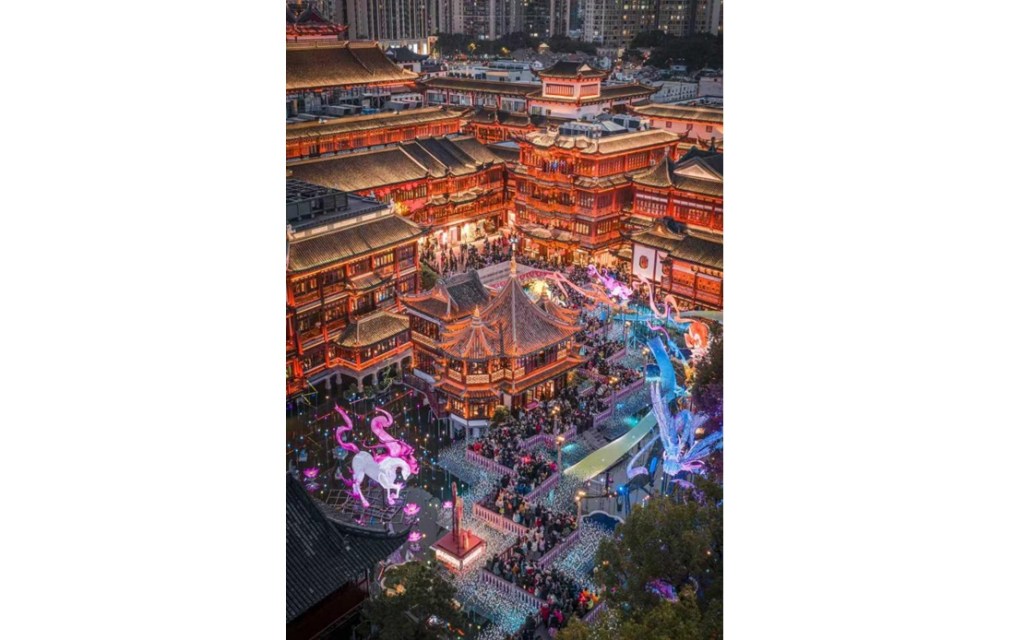
The blend of Shanghai-style Chinese New Year vibes and trendy Chinese cultural elements boosted the festive folk atmosphere in the city. Centering on experiencing the vibe of ordinary life, Shanghai launched a city-wide lantern show campaign. The lantern shows at Yuyuan Garden and the Inlet lit up the city’s nights with stunning light displays.

Intangible cultural heritage fairs and master chefs’ kitchens were set up in urban cultural and tourism complexes and suburban ancient towns. Some high-end hotels have integrated intangible cultural heritage into one-stop stays that integrate accommodation, dining, and travel experiences. Local traditional delicacies such as Shanghai cuisine and Nanxiang steamed buns offered visitors authentic Chinese New Year flavors.

Looking forward, Shanghai will further integrate cultural and tourism resources, pursue continuous product innovation, boost the upgrading of cultural and tourism consumption, and let more people feel the hospitality and vitality of Shanghai’s cultural and tourism industry.

Source: Shanghai Municipal Administration of Culture and Tourism

“Taste Hong Kong,” a Chef-Curated Gourmet Guide to the City’s True Culinary Soul

More than 50 master chefs handpick 250 restaurants to showcase the authentic flavours of Hong Kong’s neighbourhoods 

HONG KONG, Jan 23 (Bernama-GLOBE NEWSWIRE) — Hong Kong’s longstanding reputation as one of the world’s great food cities has been built on contrast — a destination where humble street stalls sit comfortably alongside polished Michelin-starred dining rooms, and where “Great Taste” can be found everywhere in Hong Kong. This season, the Hong Kong Tourism Board (HKTB) celebrates the city’s rich culinary culture with the launch of Taste Hong Kong, a new gourmet guide developed in collaboration with the Chinese Culinary Institute (CCI) that invites visitors to experience the city through the eyes — and appetites — of its master chefs.

Taste Hong Kong is a chef-curated culinary guide to the city’s diverse neighbourhoods. More than 50 master chefs — all graduates of CCI’s prestigious Master Chef Course in Chinese Cuisine — have collectively handpicked 250 restaurants throughout Hong Kong, shining a spotlight on the places they return to time and again. The guide offers a comprehensive and refined overview of the city’s culinary landscape, highlighting a rich tapestry of Chinese cuisines alongside an array of international flavours, from traditional noodle shops and classic dessert parlours to family run local gems, artisanal cafés, upscale hotel restaurants, and Michelin-starred fine dining destinations. Going beyond conventional rankings and accolades, the guide provides an authoritative, insider perspective on the city’s most authentic and distinctive gastronomic experiences.

At the heart of Taste Hong Kong are the chefs themselves. As the creative minds behind some of Hong Kong’s most celebrated dining rooms, they bring a rare perspective on what defines a great meal — and what makes a restaurant endure. Among them are acclaimed figures such as Adam Wong and Lee Man-sing, who have each contributed personal recommendations that reflect both their culinary roots and their deep connection to Hong Kong’s dining culture.

“When I think about Hong Kong food, I think about the neighbourhood places I always go back to — dai pai dongs, cha chaan tengs and small restaurants that define the city’s everyday dining culture. These spots reflect how locals really eat and the city’s culinary soul. I am excited to be part of this guide because it gives visitors a genuine way to experience Hong Kong through the food and neighbourhoods that locals know and love,” says Adam Wong, a 3-star Michelin Executive Chef at the Forum Restaurant.

“I have always believed that some of Hong Kong’s best food is found in the simplest settings, whether it’s a comforting bowl of noodles or hot pot shared with friends. The restaurants highlighted in Taste Hong Kong are places with history, consistency and heart. They show why Hong Kong is one of the world’s most exciting cities to eat in,” says Lee Man-sing, Executive Chef of Mott 32 Group.

Designed for both visitors and locals, Taste Hong Kong organises its 250 restaurant picks by neighbourhood. With various neighbourhoods represented, travellers are encouraged to venture beyond well-trodden dining districts and experience the distinctive character of each area. From sizzling woks in bustling street kitchens to quiet neighbourhood favourites passed down through generations, the chefs’ selections offer visitors and locals a deeper insight into Hong Kong’s rich culinary heritage and vibrant diversity, guiding them to the true “Great Taste” of the city.

The guide is supported by a rich suite of digital content, including neighbourhood videos and curated maps, hosted on the campaign’s dedicated website. A downloadable digital edition of the Taste Hong Kong guide will also be available, serving as an easy-to-use companion for planning meals and neighbourhood discovery. QR codes will be displayed at various MTR stations, bus shelters and visitor signage across neighbourhoods. HKTB will also broadcast the “Taste Hong Kong promotional video at major tourist hotspots, and prominent shopping malls and hotels across the city, reinforcing Hong Kong’s status as a global gourmet capital where exceptional food can be found everywhere — often in the most unexpected places.

To discover the full Taste of Hong Kong guide and begin your culinary adventure, visit tastehk.discoverhongkong.com. Download the digital guide, watch the neighbourhood videos and join the conversation using #TasteHongKong to discover the authentic flavours that define Hong Kong, one neighbourhood at a time.

Media can download photos at the following link:
https://assetlibrary.hktb.com/assetbank-hktb/action/browseItems?cachedCriteria=1&categoryId=2323&categoryTypeId=2&allCats=0

For media enquiries, please contact:

Ms Holly Chan
Tel: 2807 6206
Email: holly.chan@hktb.com 
Ms Irene Tsang
Tel: 2807 6541
Email: irene.tsang@hktb.com  

Photo accompanying this announcement are available at:
https://www.globenewswire.com/NewsRoom/AttachmentNg/2dabc68d-9bfd-4f1b-a708-40865a2acdec
https://www.globenewswire.com/NewsRoom/AttachmentNg/d7b089ab-153d-4098-b587-c33148715edf
https://www.globenewswire.com/NewsRoom/AttachmentNg/50b198ca-9764-4305-991c-fff01c8fd669

SOURCE: Hong Kong Tourism Board

GUIGANG’S 15TH LOTUS CULTURE SERIES BLOOMS, DRIVING TOURISM, SMART CULTURAL GROWTH

KUALA LUMPUR, Aug 18 (Bernama) — Guigang, Guangxi in China, has officially launched the 15th Lotus Culture Series, a multi-month celebration that blends tradition, culture, and technology to fuel the city’s booming tourism sector.

Running from July to October, the event will feature theatrical performances, poetry contests, and the selection of “Top Lotus-Viewing Spots”, all aimed at deepening visitor engagement and cultural pride.

Endowed with exceptional ecological strengths, Guigang is building an ecotourism destination serving the Guangdong-Hong Kong-Macau Greater Bay Area and ASEAN, with its “Three Mountains, One Gorge, One Culture” as the core.

Currently, the city boasts 52 national A-level tourist attractions, 37 rural tourist areas rated four-star or above, and 17 themed tourism camps, while its brand “Camping Paradise, Carefree Guigang” is gaining increasing acclaim.

According to the Publicity Department of Guigang City in a statement, Guigang welcomed over 32 million tourists in the first half of 2025, generating 30.121 billion Chinese yuan in tourism revenue, up 12.88 per cent and 13.87 per cent year on year, respectively. (100 Chinese yuan = RM58.82)

To extend its reach, the city is leveraging performances and events to boost urban development, which include the Guangxi division of the “Village Basketball Association”, the “Douyin Football Carnival”, the “Gangren Gangye Concert”, along with the hosting of the 15th National Games Basketball Qualifiers, highlighting its reputation as a “City of Sports, Capital of Leisure”.

The Douyin event alone earned 1.83 billion online exposures, pushing Guigang into the top three of Douyin’s city search rankings. These events generated significant spikes in hotel stays and local consumption, demonstrating a clear “event-driven, extended-stay” tourism pattern.

To sustain this momentum, Guigang is stepping up its three-year intensive campaign for the cultural and tourism industry, signing 22 new projects worth 2.401 billion Chinese yuan and accelerating 42 key cultural and tourism projects in the first half of 2025.

The city is also pushing forward with “culture-tourism + AI” integration, recently launching an artificial intelligence (AI)-powered interpretation system at the Pingnan County Museum.

With the Lotus Series in full bloom, Guigang once again embraces its millennium-old heritage as the “Lotus City”—inviting the world to explore its vibrant mix of natural beauty, cultural depth, and technological innovation.

— BERNAMA