
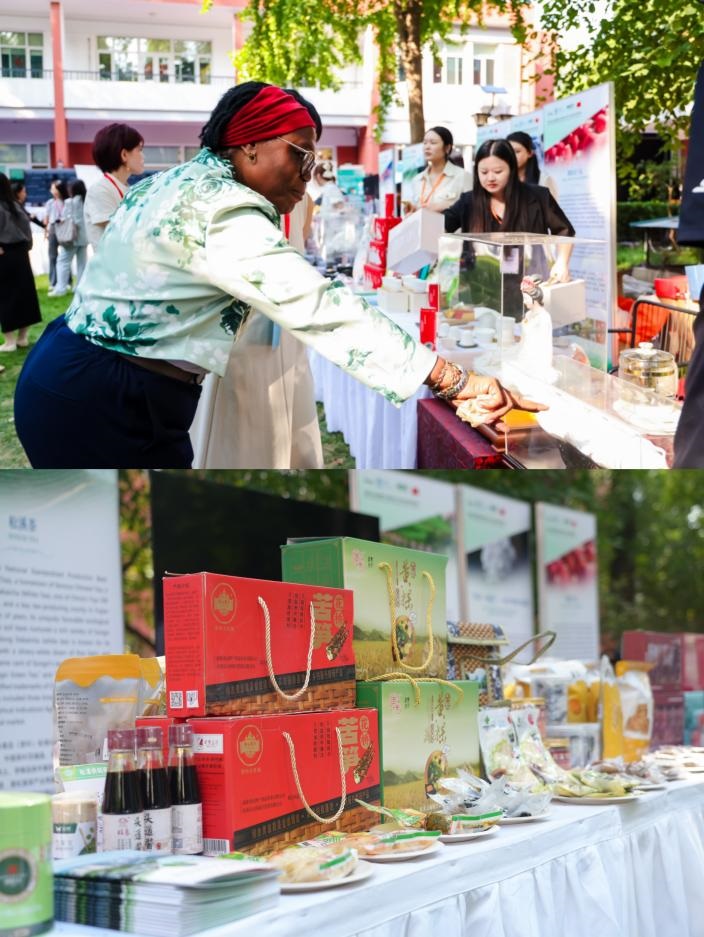
Dehua white porcelain, Songxi agricultural products shine at UN Building, Beijing

Table

Dehua white porcelain, Songxi agricultural products shine at the United Nations Building in Beijing in September.

FUZHOU, China, Sept. 30, 2026 /Xinhua-AsiaNet/–

In September, the IFAD-SSTC Marketplace on Agricultural Technology Innovation and Investment opened at the United Nations Building in Beijing. Hosted by the International Fund for Agricultural Development (IFAD), the event aimed to build a targeted South-South cooperation platform to showcase China’s agricultural achievements and share replicable solutions. Over 120 participants attended, including diplomats from 17 embassies and representatives from seven UN agencies in China.

Dehua County, a mountainous county in southeast China’s Fujian Province, brought white porcelain works including Flourishing Flower Basket and Quanzhou Nanyin (a sculpture inspired by UNESCO-listed Nanyin music from Quanzhou, a historic port city in Fujian), alongside wild red mushrooms, alpine tea oil and Chinese yam. Nii Quaye-Kumah, IFAD Representative in China, said he was “deeply impressed” by the exquisite ceramic artistry. Julio Worman, IFAD analyst for Latin America and the Caribbean, inquired about porcelain-making techniques and watched a tea ceremony. “Despite vast cultural differences between East and West, there are striking similarities,” he said. “It was a wonderful tasting experience.”

Dehua, one of the birthplaces of Chinese ceramic culture, is a national white porcelain hub with over 4,000 enterprises generating 76 billion yuan (approx. £7.9 billion / $10.7 billion) annually. It is China’s largest producer and exporter of ceramic crafts, tea sets and planters. Dehua aims to share its porcelain’s beauty with a wider international audience.

Songxi County, a rural county in Nanping City and its sole county-level exhibitor, presented century-old sugarcane pastries, Huaqiao bitter bamboo shoots (a local variety named after Huaqiao Township), Jiulong white tea (literally “Nine-Dragon White Tea”), green tea, black tea and matcha. Ama Brandford-Arthur, IFAD Global Coordinator for South-South and Triangular Cooperation, said Songxi had successfully linked rare germplasm resources, traditional farming and modern branding to bring mountain produce to market, a model with valuable lessons for the Global South.

Wu Wei, Secretary of Songxi County, said the exhibition offered a vital opportunity to advance opening-up and deepen international agricultural cooperation. Songxi will use the platform to absorb advanced ideas, pool quality resources and drive industrial upgrading.

Nestled between Wuyi Mountain (a UNESCO World Heritage Site) and Baishanzu National Park, Songxi is home to a sugarcane planting system first established in 1727 during the Qing Dynasty, with the mother cane still sprouting after nearly 300 years. Local teas hold national geographical indication certifications, and the Songxi bamboo sugarcane cultivation system is recognised as a China Important Agricultural Heritage.

During the event, guests discussed cross-border agricultural trade, technology exchange and value-chain enhancement. Both stands emerged as the most-visited, broadening international visibility and injecting fresh momentum into China’s county-level speciality industries going global.

SOURCE: Publicity Department of the Dehua County Committee & Publicity Department of the Songxi County Committee

Rolling Through History: Discover Gunshanzhu, Guizhou’s Legendary Miao Dance

Gunshanzhu trainees in Zhuchang Township, Nayong County, Bijie City, Guizhou Province, perform the traditional climbing formation.

BIJIE, China, Aug. 5, 2026 /Xinhua-AsiaNet/–

Deep in the mountains of Zhuchang Township, Nayong County, Bijie City, Guizhou Province, a unique Miao ethnic dance has been passed down for generations. Known as gunshanzhu, or the “Pearl of the Guizhou Plateau,” this remarkable art form is more than a performance. It carries the memories of Miao migration, rich cultural traditions, and the enduring spirit of the Miao people.

According to legend, during the ancient migration of the Miao people, their journey was filled with rugged mountains and thorny paths. To help their people pass through the wilderness, brave Miao youths used their own bodies to roll through the thorn bushes, creating a path for their community. To honor this courage and hardship, later generations recreated these rolling movements and developed them into a unique lusheng dance. Every roll is a tribute to their ancestors. Every leap reflects the resilience of the Miao people.

Gunshanzhu is one of the most challenging forms of Miao ethnic dance. Performers wear embroidered white jackets and pheasant-feathered hats while playing six-pipe lusheng instruments. The greatest challenge is that the melody must never stop. Even while performing extremely difficult movements, dancers must continue playing the lusheng without interruption.

During performances, dancers roll and spin between bowls filled with water, balancing their bodies with remarkable precision. They perform breathtaking movements such as the Flying Swallows, Human Pyramid, and Rolling Dragon. The seamless combination of music, movement, breath, and strength creates the unique beauty of this ancient art.

Since the 1990s, gunshanzhu has earned recognition both at home and internationally for its unique artistic value and cultural significance. In 2006, it was included in the first batch of China’s national intangible cultural heritage list.

Behind its preservation is the decades-long dedication of Wang Jingcai, a national-level inheritor of gunshanzhu. By incorporating acrobatic elements into the traditional dance, he helped bring this art form from remote communities to the world stage. Today, local schools have introduced gunshanzhu courses, allowing younger generations to continue this cultural legacy.

Gunshanzhu is a living historical record and a symbol of the Miao people’s perseverance. When the sound of the lusheng rises and dancers begin to roll and leap, audiences witness more than extraordinary skills. They see a thousand-year-old memory, a cherished tradition, and the enduring spirit of a people.

Source: Nayong Yongkang Cultural Tourism Investment & Development Co., Ltd.

–BERNAMA

Ancient Port, New Voyages: Ningbo’s Smart Manufacturing Expands Global Trade Footprint via Maritime Silk Road

NINGBO, China, July 7, 2026 /Xinhua-AsiaNet/–

On July 4, 2026, the cultural exchange event Encounter & Insight: Dialogue Between Ningbo, China and Colombo, Sri Lanka  took place in Colombo. 

Separated by thousands of miles, the two millennia-old port cities reconnected, leveraging their ports as a bond and cultural exchanges as a cohesive force to hold in-depth talks on integrated port-city development and bilateral economic and trade connectivity.

This cross-Indian Ocean dialogue echoes the ancient Maritime Silk Road while charting a brand-new outbound development path. As a pivotal starting port of the ancient Maritime Silk Road, Ningbo is building a new global trade landscape powered by smart manufacturing.

A thousand years ago, merchant vessels from Mingzhou Port set sail southward loaded with Yue Kiln celadon porcelain, passing through Ceylon to deliver Oriental crafts across the Indian Ocean coasts. Precious gemstones and spices traveled the same sea route back to regions south of the Yangtze River, laying the groundwork for the earliest cultural exchange between the two ports through trade. Today, the cargo carried by giant cargo ships has undergone a dramatic transformation. Beyond traditional daily necessities, intelligent equipment, digital home appliances and industrial robots now dominate shipments.

Official statistics show that Ningbo’s exports of intelligent equipment, including mechanical arms and industrial robots, hit 440 million yuan in 2025, surging more than 40% year-on-year. From January to May this year, Ningbo’s exports of mechanical and electrical products maintained steady growth, reaching 247 billion yuan, a 4.1% year-on-year increase and accounting for 58.0% of the city’s total export volume. The new energy foreign trade sector saw explosive growth, with exports of new energy vehicles, lithium batteries, and photovoltaic products jumping 138.4% year-on-year, with electric vehicle exports skyrocketing 215.9%. Smart manufactured goods are continuously expanding the scope of Ningbo’s foreign trade.

Complementing the Colombo forum, an exhibition highlights Ningbo’s outstanding going-global enterprises and their products, vividly illustrating the profound shift in Ningbo’s trade structure.

Alongside time-honored Maritime Silk Road staples such as celadon porcelain and silk, Ningbo’s smart manufactured products – including AI translation glasses, intelligent outdoor gear and digital small home appliances – occupy prominent display spaces across the venue. In Sri Lanka, Ningbo smart water meters are widely adopted nationwide, while handheld cooling fans and intelligent kitchen appliances have entered ordinary households.

Leveraging Colombo Port’s transshipment advantages, massive volumes of Ningbo smart manufactured goods are distributed onward to Europe, the Middle East and beyond. What Ningbo exports today is no longer mere commodities, but a complete outbound solution integrating technology, brand value and after-sales services.

Faced with mounting challenges including homogeneous global market competition and rising trade barriers, Ningbo’s manufacturing sector has abandoned the old model of low-cost OEM production, relying on intelligent transformation to consolidate its competitive edge in overseas markets.

Over more than a decade of digital transformation efforts, Ningbo has achieved full digital upgrading of all industrial enterprises above designated size. A large number of local factories have built unmanned black-light workshops and flexible production lines, escaping vicious price competition through continuous technological iteration. Represented by five specialized, sophisticated, distinctive and innovative enterprises dubbed Ningbo’s “Five Little Tigers” – famous for their core proprietary technologies, including highly sophisticated visual inspection equipment, heat-resistant materials, sun-proof coatings, puncture-proof materials and self-drilling fasteners – these niche manufacturers have developed differentiated technical routes and full-spectrum production capacity, cementing irreplaceable competitiveness for Ningbo smart manufacturing on global markets.

Beyond trade expansion, Ningbo has built a supporting cultural communication system to ensure “products go global, accompanied by local culture”.

The launch of Sri Lanka’s first “One-Meter Cultural Space” cultural station during the Colombo event marks a tangible milestone of Ningbo’s go-global initiative. Built on enterprises’ overseas outlets, these miniature cultural exhibition halls integrate intangible cultural heritage crafts, urban stories and smart products, enabling overseas clients to experience cutting-edge manufacturing while gaining insight into Ningbo’s profound cultural heritage.

During the twin-city story-sharing session, Ningbo entrepreneurs based in Sri Lanka and local designers blending Chinese and Sri Lankan aesthetics shared stories of bilateral exchanges. Economic and trade ties have evolved into a bond for people-to-people communication, bridging divides in cross-cultural trade.

From Tang-dynasty celadon porcelain sailing across the Indian Ocean to intelligent equipment shipping to every corner of the globe, Ningbo, the ancient Maritime Silk Road port, has preserved its enduring gene of openness. Where exchanges once relied purely on commodity trade, today smart manufacturing underpins a stable, diversified and high-value-added global trade network.

The Ningbo-Colombo dialogue stands as a vivid microcosm of this transformation: the port still links lands and seas, yet the core of its trade has undergone a full intelligent upgrade.

Rooted in its historical legacy as a key Maritime Silk Road hub, Ningbo has consolidated its industrial foundation through a decade of digital development, expanded global market reach via worldwide port networks, and softened trade cooperation through cultural exchanges. This brand-new outbound shipping route forged by smart manufacturing has not only reshaped the city’s foreign trade landscape, but also delivered a replicable port-city development model for Chinese manufacturing to go global.

Source: Ningbo International Communication Center

PROFESSOR SPYRIDON FLOGAITIS HONOURED WITH 2025 GLOBAL CITIZEN AWARD

KUALA LUMPUR, Nov 4 (Bernama) — The prestigious Global Citizen Award has recognised distinguished legal scholar and advocate for public governance, Professor Spyridon Flogaitis for his lifelong commitment to strengthening democratic institutions, upholding the rule of law, and expanding legal access for vulnerable communities.

The annual tribute is presented by leading international residence and citizenship advisory firm Henley & Partners, in partnership with the Swiss non-profit humanitarian organisation Andan Foundation.

“Professor Flogaitis has demonstrated how the law can be a transformative force for peace, dignity, and inclusion. His commitment to justice, democratic resilience, and cross-border collaboration exemplifies what it means to be a global citizen,” said Henley & Partners Chairman and Andan Foundation Founder, Dr Christian H. Kaelin.

Presented at a gala reception during the 19th annual Global Citizenship Conference in London, the award honours individuals who show exceptional courage and commitment towards improving and supporting the global community.

Professor Flogaitis received the Global Citizen Award for his tireless work in advancing public law, legal education, and institutional reform, particularly in regions facing democratic fragility and post-crisis recovery.

As Director and President of the Board of the European Public Law Organization (EPLO), he has led groundbreaking initiatives to improve local governance, train civil servants, and expand access to justice for marginalised groups.

His efforts have had a lasting impact in Southeastern Europe and beyond, fostering legal frameworks that uphold human rights and enable civic participation, Henley & Partners said in a statement.

The Global Citizen Award selection process is based on a majority decision of the Global Citizen Award Committee. The award comprises a bespoke sculptural medal designed by Italian artist Antonio Nocera, an award certificate signed by the Committee Chairman, and a monetary prize of US$20,000 to support the recipient’s humanitarian work. (US$1 = RM4.19)

Henley & Partners also commits to a year-long collaboration with the recipient to raise awareness and amplify their impact through its global network of more than 70 offices.

— BERNAMA

PACIFIC PRIME LEADS EARTHQUAKE RELIEF EFFORT IN NORTHERN CEBU

KUALA LUMPUR, Oct 31 (Bernama) — Pacific Prime has successfully led an emergency relief mission to support victims of the earthquake that struck northern Cebu last month, leaving hundreds displaced, mourning, and in urgent need of shelter, food, and clean water.

In a statement, Pacific Prime said 57 team members and volunteers helped gather and pack relief goods, with 25 volunteers travelling north to deliver supplies directly to the most severely affected areas.

In addition, staff from Pacific Prime offices in Cebu, Singapore, and Dubai contributed generously, with donations matched by global leaders Neil Raymond and Vittoria Depino. A total of US$5,400 was raised, allowing the team to support over 450 individuals and families across five municipalities. (US$1=RM4.19)

“In times of crises, our team rises – driven by compassion, collaboration, and community spirit. A huge thank you goes out to all the volunteers for their dedication and courage, enduring long hours and tough conditions.

“It is truly inspiring to be part of an organisation that leads with heart, one that lives its values of Impact, Courage, and Selflessness,” said Pacific Prime Cebu head, Lohrie May Labra.

The initial wave of aid reached 354 families and individuals, while the following week, with remaining funds and support from Lacson & Lacson, additional relief such as drinking water, blankets, sleeping mats, and sacks of rice was delivered to over 100 residents still living in tents due to ongoing aftershocks.

This initiative, while not part of the originally planned corporate social responsibility (CSR) activities for the year, became one of the most meaningful, reflecting Pacific Prime’s commitment to its CSR pillars, where Community stands as a core value – driving efforts to support those in need and build resilience in times of crisis.

Established in 2000, Pacific Prime is an award-winning global insurance brokerage and employee benefits specialist that offers individual and corporate insurance solutions.

— BERNAMA