MALAYSIA INCREASING IT’S CAPABILITIES IN EARLY PHASE CLINICAL RESEARCH

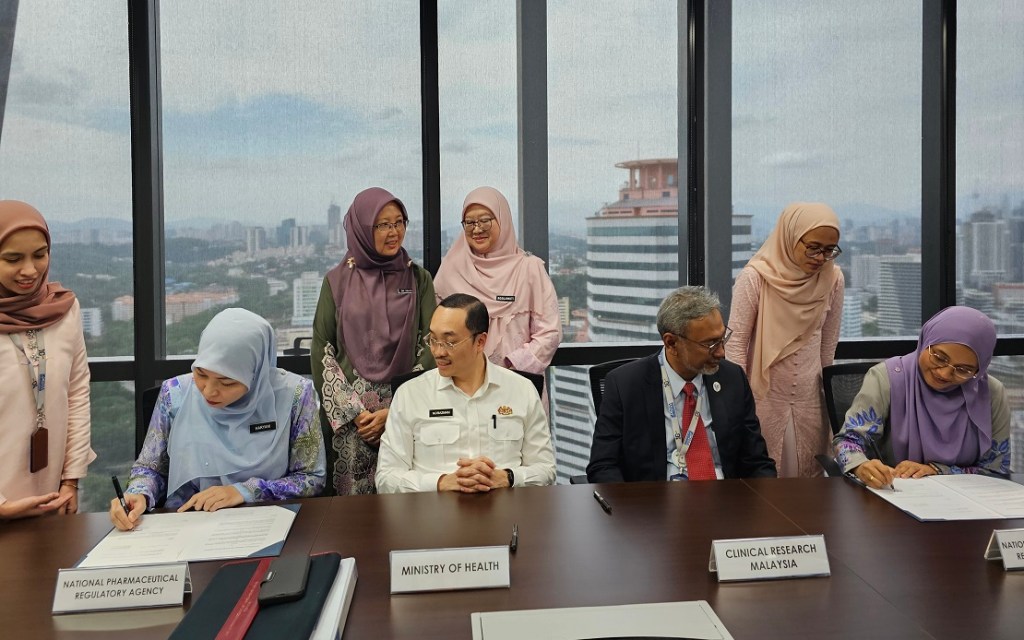
Signing of education scholarship agreement, witnessed by Minster of Health & Director of National Pharmaceutical Regulatory Agency

KUALA LUMPUR, July 26 (Bernama) — Clinical Research Malaysia (CRM) inked an education scholarship agreement with the Ministry of Health (MOH) and National Pharmaceutical Regulatory Agency (NPRA) earlier today at CRM headquarters. Under the agreement, CRM will be sponsoring two NPRA officers to pursue their Master’s program in Clinical Pharmacology at King’s College London.

The initiative is aligned with CRM’s Phase 1 Realisation Project (P1RP) 2.0, which focuses on further enhancing Malaysia’s capabilities on early phase/first-in-human trials. The project is an extension of the initial P1RP program launched in 2016 in which three NPRA officers and a Medical Oncologist from Sarawak General Hospital were sponsored for postgraduate studies and fellowship attachment respectively, at renowned global institutions, to build their expertise in early phase trials. Investment in human capital development is a continuous effort taken by CRM, an organization wholly-owned by the MOH, to ensure the country’s readiness for safe and high-quality conduct of clinical trials.

Representing the organisations at the signing ceremony were Deputy Secretary-General Finance of MOH, Dato’ Sri Norazman Ayob, Chief Executive Officer of CRM, Dr. Akhmal Yusof as well as NPRA officers Siti Norhayani Ismail and Fatin Diyana Fauzi. The sponsorship agreement was witnessed by YB Dr. Zaliha Mustafa, the Minister of Health and Rosilawati Ahmad, NPRA Director.

During the same program, YB Dr Zaliha also launched the Malaysia Decentralised Clinical Trial (DCT) Guidance Document. This guidance document is a first in Malaysia and will be an important step in aligning to the global trends of clinical trials where patient-centricity becomes more important, as well as adopting new and innovative clinical trial designs. The document was developed by clinical research stakeholders within the country and endorsed by the National Committee for Clinical Research.

About CRM
Established by Malaysian Ministry of Health in 2012, Clinical Research Malaysia is a Global Trusted Research Management Organisation guided by principles of HUMANITY, STABILITY & SUSTAINABILITY in providing global clinical trial solutions. CRM enables Speed, Reliability & Quality delivery of Sponsored Clinical Trials through innate understanding of the local clinical research landscape with the international standards of operations. These coupled with fundamental backing of the government ministries provides the organisation an incomparable advantage to work with partners from the nascent stages of development to materialisation of the end product, in order to deliver better treatment and high-skilled job opportunities.

SOURCE: Clinical Research Malaysia (CRM)

FOR MORE INFORMATION, PLEASE CONTACT:
Name: Siti Khadijah Sakaria 
Tel: + 6017 696 3596 | +603-7931 5566 (ext. 119)   
Email: sitikhadijah@clinicalresearch.my 

–BERNAMA

CURIA-TOUCHLIGHT ALLIANCE EXPANDS BIOLOGICS CAPABILITIES WITH ACCESS TO ENZYMATIC DOGGYBONE DNA

KUALA LUMPUR, July 25 (Bernama) — Curia, a contract research, development and manufacturing organisation, and Touchlight, a company pioneering enzymatic DNA production, announced an agreement which will provide Curia and its clients a streamlined means of access to Touchlight’s doggybone DNA (dbDNA).

The arrangement expands Curia’s messenger ribonucleic acid (mRNA) manufacturing offerings with an additional differentiated source of DNA raw material that is immediately available to be accessed by Curia customers, while Touchlight will directly manufacture dbDNA on behalf of Curia’s customers.

“Curia remains committed to strengthening our biologics offerings and end-to-end mRNA manufacturing capabilities.

“With the addition of enzymatic DNA through our partnership with Touchlight, our customers will have a critical advantage in terms of scalability and speed to market,” said Curia President of R&D, Christopher Conway in a statement.

Meanwhile, Touchlight Chief Executive Officer, Karen Fallen said: “We are delighted to work with Curia in order to further expand access to dbDNA as a critical starting material.

“Curia is building a comprehensive mRNA solution, and this arrangement enables both companies to extend their offering to a wider audience.”

Touchlight’s dbDNA is a linear, double-stranded, covalently-closed DNA vector. DNA serves as the template for making mRNA therapies, and via a simple enzymatic process called in vitro transcription, genetic information is copied from DNA to mRNA.

This mRNA is then able to teach the cells to make precise proteins that are used to treat or prevent diseases. Touchlight’s enzymatic DNA is produced with a cell-free enzymatic process that offers unmatched benefits in speed, quality and capacity when compared to traditional plasmid DNA production.

— BERNAMA

CHINA-SINGAPORE TIANJIN ECO-CITY UNVEILS PLAN ON CARBON PEAKING AND NEUTRALIZATION

TIANJIN, China, July 25, 2023 /Xinhua-AsiaNet/–

China-Singapore Tianjin Eco-City in north China’s Tianjin Municipality has issued an action plan on carbon peaking and neutralization in the bilateral project’s latest move to boost green development, according to China-Singapore Tianjin Eco-City Administrative Committee.

With a focus on four key areas of industry, construction, energy and transportation, the action plan seeks to build a pioneering demonstration zone for carbon neutralization, and create a batch of low-carbon and zero-carbon demonstration carriers and carbon reduction landmark projects in a bid to set up models for the whole country and even the world.

By 2025, the per capita carbon emissions in the eco-city will be significantly lower than the average level of Tianjin. By 2030, carbon dioxide per unit of regional GDP and carbon emissions per capita will be among the lowest in China, according to the plan.

The science park in the eco-city’s south, the information park in the middle and the industrial park in the north will form major carriers for the region to build a green and low-carbon industrial cluster featuring a focus respectively on innovation, industrial transformation and manufacturing in different parts.

The southern part of China-Singapore cooperation zone and the Linhai New City area focus on developing technology-based and service-oriented low-carbon industries such as biomedicine, software and cultural tourism. The cooperation zone’s central area will highlight software and hardware integration to support the transformation and application of scientific research outcomes.

The northern part of the cooperation zone and the northern part of the Binhai Tourism Zone will develop solid low-carbon manufacturing industries like intelligent manufacturing, medical devices and intelligent connected vehicles. The central fishing port area will build a green industrial chain integrating warehousing, processing, trade and finance.

As the first national green development demonstration zone, the eco-city advocates ultra-low energy consumption, near-zero energy consumption and zero-energy buildings, seeking to construct low-carbon residential buildings and zero-carbon public buildings. The region will push for the implementation of ultra-low energy consumption standards for all new residential buildings and near-zero energy standards for new government-invested public buildings.

Besides, the eco-city will enhance the operation efficiency of the heating pipe network, cut the heating energy consumption per unit area, integrate building construction with photovoltaic development by supporting complete coverage of installation of solar energy facilities in residential buildings.

“The eco-city will accelerate the development of renewable energy, increase its integration with urban construction, explore the development and utilization of diversified clean energy, and increase the proportion of green electricity use, and make full use of the roofs of new buildings and existing buildings for distributed photovoltaic installation,” according to an official with the eco-city ecological environment bureau.

The plan also formulates specific tasks on green intelligent travel system, such as building a suitable and comfortable slow travel system, laying high-quality pedestrian lanes, and advocating green and low-carbon development through the whole process of transportation infrastructure planning, construction, operation and maintenance.

The China-Singapore Tianjin Eco-City is a major cooperation project between the two countries. It is the world’s first eco-city jointly developed between countries and seeks to address global climate change, strengthen environmental protection, save resources and energy, and provide a model for sustainable urban development. It began construction on September 28, 2008.

Source: China-Singapore Tianjin Eco-City Administrative Committee

–BERNAMA

ST KITTS AND NEVIS INTRODUCES MANDATORY INTERVIEWS TO CONFIRM ITS STATUS AS THE BEST REGULATED CITIZENSHIP BY INVESTMENT PROGRAMME IN THE CARIBBEAN

Basseterre, July 20 (Bernama-GLOBE NEWSWIRE) — St Kitts and Nevis has yet again strengthened the administration of its Citizenship by Investment (CBI) Programme, announcing that all main applicants are to partake in a mandatory interview as part of the application process to its investment migration programme.

The twin-island Federation becomes one of the first Caribbean nations to introduce the soon-to-be industry standard. Instituted by regulations published on July 19, 2023, the new policy applies to all applications, including those already received but not yet approved by the Citizenship by Investment Unit (CIU). The new regulations also provide that dependants may be asked to be interviewed.

This new step in St Kitts and Nevis’ CBI application process confirms that St Kitts and Nevis has now fully implemented the six principles agreed between the United States of America and governments of the five Caribbean nations with Citizenship by Investment Programmes in a roundtable meeting held on February 25, 2023. That meeting was convened to discuss and agree on common ways to deal with threats to international communities in the investment migration ecosystem.

The five Caribbean participating governments are Antigua & Barbuda, Dominica, Grenada, St Kitts and Nevis and Saint Lucia. Their Prime Ministers and other senior state officials met with a USA delegation led by Anna Morris, Deputy Assistant Secretary at the USA Department of Treasury.

The group collectively committed to six CBI principles proposed by the USA, several of which were already adopted by the five Caribbean participating governments of their own volition as part of their risk management framework to strengthen and safeguard the integrity of their CBI programmes.

The six principles agreed were:

  1. Treatment of denials: Not to process applications from persons whose applications have been denied in another CBI jurisdiction, by proactively sharing information on denials.
  2. Interviews: Conduct interviews with applicants, whether virtual or in-person.
  3. Additional checks: Each jurisdiction will run checks on each application with the Financial Intelligence Unit of its respective country.
  4. Audits: Audit the Programme annually or every two years in accordance with internationally accepted standards.
  5. Retrieval of passports: Request law enforcement assistance to retrieve revoked/recalled passports.
  6. Treatment of Russians and Belarusians: Suspend processing applications from Russians and Belarusians.

A delegation from St Kitts and Nevis, headed by the country’s Prime Minister, Terrance Drew, also attended this year’s annual European Union-Community of Latin American and Caribbean States Summit (EU-CELAC) Summit in Brussels.

During the Summit, St Kitts and Nevis, along with the other Caribbean CBI islands, met with the European Commission and agreed to establish a joint task group to engage the stakeholders and keep both regions abreast of ongoing developments and find a common ground to work from.

“We are very happy about how the meeting went in Brussels. There is definitely a spirit of cooperation between ourselves and the European Commission, and we will continue to make our efforts in mitigating international security risk very clear so all our international partners are confident of the integrity of our programme,” noted Prime Minister Drew.

The third edition of EU-CELAC was held from July 17 to July 18, 2023, and aims to discuss key matters of interest that impact the Caribbean and the European Union and effective resolutions. 

From July 19, 2023, main applicants, 16 years and older, for St Kitts and Nevis’ CBI programme will be required to be interviewed – virtually or in person – as part of the application process.

Head of St Kitts and Nevis’ Citizenship by Investment Unit, Michael Martin, commented that “St Kitts and Nevis remains committed to cooperating with our international stakeholders and takes the safety and integrity of our Citizenship by Investment Programme extremely seriously.”

Due diligence and risk mitigation remain a very important aspect of how St Kitts and Nevis approaches its CBI programme.

The country has one of the best regulated programmes in the world. St Kitts and Nevis is the only country with a CBI Board of Governors responsible for providing general oversight of the operations their CBI Unit; developing and implementing policies and procedures; ensuring that application processing is completed within the timeframes advertised without compromising the integrity of the programme; and constantly monitoring the global investor immigration industry to ensure that the country’s CBI Regulations align with international market forces.

The country is the also the only one with a CBI Technical Committee charged with ensuring all due diligence background checks are comprehensive in keeping with the country’s multi-sectoral good governance transformation into a sustainable island-state.

Caribbean CBI nations remain at the pinnacle of due diligence excellence and St Kitts and Nevis continues as a trailblazer for many CBI nations across the world.

The due diligence for the St Kitts and Nevis CBI Programme is conducted by highly respected international due diligence agencies from the USA, Canada and the United Kingdom, and vetted by the CBI Unit, Financial Intelligence Unit and international policing authorities. These agencies work together to facilitate a multi-layer due diligence investigation online and on-the-ground.

St Kitts and Nevis boasts the oldest CBI programme in the Caribbean, established in 1984, and continues to be a firm favourite among international investors across the world.

Secretary of St Kitts and Nevis Citizenship by Investment
Government of St. Kitts and Nevis
001 (868) 467 1474
info@sknciu.com

SOURCE : Government of St. Kitts and Nevis

MAJOR SHAKE-UP IN WORLD’S PASSPORT POWER RANKING

LONDON, July 18 (Bernama-GLOBE NEWSWIRE) — Japan has been knocked off the top spot on the Henley Passport Index for the first time in five years and bumped into 3rd place, according to the latest ranking, which is based on exclusive and official data from the International Air Transport Association (IATA). Singapore is now officially the most powerful passport in the world, with its citizens able to visit 192 destinations out of 227 around the world visa-free. Germany, Italy, and Spain all move up into 2nd place with visa-free access to 190 destinations, and Japanese passport holders join those of six other nations — Austria, Finland, France, Luxembourg, South Korea, and Sweden — in 3rd place with access to 189 destinations without a prior visa.

The UK appears to have finally turned the corner after a six-year decline, jumping up two places on the latest ranking to 4th place — a position it last held in 2017. The US, on the other hand, continues its now decade-long slide down the index, plummeting a further two places to 8th spot with access to just 184 destinations visa-free. Both the UK and the US jointly held 1st place on the index nearly 10 years ago in 2014, but have been on a downward trajectory ever since. Afghanistan remains entrenched at the bottom of the Henley Passport Index, with a visa-free access score of just 27, followed by Iraq (score of 29), and Syria (score of 30) — the three weakest passports in the world.

The general trend over the history of the 18-year-old ranking has been towards greater travel freedom, with the average number of destinations travelers are able to access visa-free nearly doubling from 58 in 2006 to 109 in 2023. However, the global mobility gap between those at the top and bottom of the index is now wider than it has ever been, with top-ranked Singapore able to access 165 more destinations visa-free than Afghanistan.

Dr. Christian H. Kaelin, Chairman of Henley & Partners, says only eight countries worldwide have less visa-free access today than they did a decade ago, while others have been more successful in securing greater travel freedom for their citizens. “The UAE has added an impressive 107 destinations to its visa-free score since 2013, resulting in a massive leap of 44 places in the ranking over the past 10 years from 56th to 12th position. Of the countries sitting in the Top 10, the US has seen the smallest increase in its score, securing just 12 additional destinations. Singapore, by comparison, has increased its score by 25, pushing it up five places over the past 10 years to number one.”

Commenting in the Henley Global Mobility Report 2023 Q3, released today alongside the latest index, Greg Lindsay from Cornell Tech’s Jacobs Institute, says that from a purely mechanical perspective, “the story is a simple one — by more or less standing still, the US has fallen behind. While its absolute score has in fact risen over the last decade, the US has been steadily overtaken by rivals such as South Korea, Japan, and Singapore. America’s relentless slide down the rankings is a warning to its neighbor Canada and the rest of the Anglosphere as well.”

The links between visa-free access and openness

Henley & Partners has conducted exclusive new research into the relationship between a country’s openness to foreigners — how many nations it allows to cross its borders visa-free — and its own citizens’ travel freedom. The new Henley Openness Index ranks all 199 countries worldwide according to the number of nationalities they permit entry to without a prior visa.

The Top 20 ‘most open’ countries are all small island nations or African states, except for Cambodia. There are 12 countries that are completely open to all passports and four that don’t allow anyone in visa-free. While the correlation between a high openness score and high visa-free access score is not straightforward, it is notable that Singapore and South Korea — high climbers on the Henley Passport Index Top 10 over last decade, moving up from 6th and 7th respectively in 2013 to 1st and 3rd today — boast relatively high degrees of openness compared to the 5 countries with the biggest disparity between the travel freedom they enjoy, versus the visa-free access they provide to other nationalities. US, Canada, Australia, New Zealand and Japan have all either slid down the ranking or remained in the same place as their openness stagnates.

Prof. Peter J. Spiro, who holds the Charles Weiner Chair in international law at Temple University, says America’s extension of visa-free access is low, even by the standard of developed economies. “EU states grant visa-free privileges to more than twice the number of states than does the US. Processing delays, high refusal rates, and a reputation for disagreeable customer service are tarnishing the attractiveness of the US as a destination. Add to that the growing reputation of the US as ridden with gun violence and one can project a long-term trajectory in which US global standing further erodes.”

Read the full Press Release

Media Contact

Sarah Nicklin

Group Head of PR

sarah.nicklin@henleyglobal.com

Mobile: +27 72 464 8965

SOURCE : HENLEY & PARTNERS GROUP HOLDINGS LTD