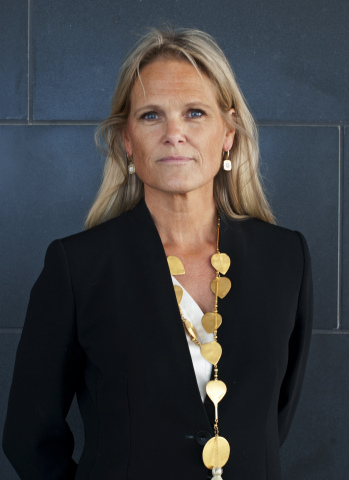
Earth Wind & Power and CEO, Ingvil Smines Tybring-Gjedde (picture) will create a sustainable bridge between the excess power in the energy industry and the power deficiency in the High Performance Computing (HPC) datacenter industry (Photo: Business Wire)
Earth Wind & Power (EWP) announced today a solid ESG solution for powering datacenters by utilizing excess energy from wind, solar and gas to cater for the increased computing power demand - without any negative impact on existing grids.OSLO, Norway, June 16 (Bernama) -- With this new practice EWP creates a long-awaited sustainable bridge between the excess power in the energy industry and the power deficiency in the High Performance Computing (HPC) datacenter industry while maintaining strong ESG-standards. Earth Wind & Power`s modular HPC datacenters utilize the most energy-efficient technologies worldwide.The company positions scalable modular datacenter units at local power production facilities around the world. The excess energy on the site is then utilized for HPC when no other offtake is commercially viable, or when demand and energy prices are low.The EWP-solution can be deployed in extremely hot climates without compromising the service levels and can provide financial incentives to initiate new renewable projects which otherwise wouldn’t be financially viable.
The CEO, Former Norwegian Minister of National Public Security and Deputy Minister of Petroleum and Energy, Ingvil Smines Tybring-Gjedde, states that: “I am proud to lead a company with strong ESG standards that is taking use of the excess energy available to power the exponentially growing demand for data processing.”EWP is currently collaborating with several energy companies to enhance their ESG-footprint by finding solutions for their excess energy.EWP is founded by pioneers from wind and solar industries and international E&P of which several are listed at the Oslo Stock Exchange.ContactFor further information contact:
Ingvil Smines Tybring-Gjedde, CEO
e-mail: post@earth-wind-and-power.com
Website; www.earth-wind-and-power.comSource : Earth Wind & Power
PETALING JAYA, June 15 (Bernama) — The Movement Control Order 3.0 (MCO 3.0) once again imposes Malaysia’s workforce to Work From Home (WFH), a necessary move to flatten the curve of COVID-19 infection as the number of deaths and positive cases are increasing by the day. This time both employers and employees are better prepared and more agile in adapting to the WFH arrangement compared to a similar situation in March 2020 when WFH came as a shock to many, just as the lockdown itself.
The arrangement of WFH or in its general term, teleworking, that is working remotely away from office premise by utilising the ICT and technological tools, seem to remain in many workplaces post-MCO, although it might not be the mainstream way of working. A hybrid model which combines the traditional workplace and teleworking may seem a plausible choice for both employers and employees upon looking at the pros and cons based on the current pandemic crisis. According to a survey conducted by the United Nations Development Programme (UNDP), 83% of employers plan or are considering WFH options post-MCO.
Teleworking is the future of work and the real new normal to job and workplaces. The advantages of teleworking are in terms of cost reduction, time saving, and overall quality of life and were cited in many studies conducted. UNDP reported that 54% of its survey respondents indicated that their quality of life improved as a result of WFH. When the overall quality of life improves, productivity increases. Along the positive side of teleworking, its negative edge also prevails. Lack of effective managerial supervision, inappropriate working space at home, lack of digital skills and infrastructure, disruption in operation, and decreasing social connectivity are the opposing sides of teleworking.
Dato’ Abdul Latif Haji Abu Seman, Malaysia Productivity Corporation (MPC) Director General said, “WFH used to be an unusual working arrangement in Malaysia, though the concept itself is not something new. Upon the first MCO in March 2020, there was a surging increase in WFH. At that time, workplaces grappled to adapt to the rapid change in the way of working. We realised that our workforce might not be agile enough to adapt quickly. We realised as well that our policy lagged in responding to the start of the new normal. Our regulations and workforce were not agile to the changes COVID-19 shock brought. At the commencement of MCO 3.0 however, workplaces are more familiar and receptive on the WFH arrangement.”
“Research indicated that productivity stays the same or has increased during WFH. UNDP reported that 76% of employees and 63% of employers remained productive or improved productivity performance during WFH. This is a positive indication that WFH is expected to be a part of our next-normal work arrangement. To ensure WFH works well, regulators and policymakers must be agile in their policymaking and regulatory designs as well as implementation. The workforce also needs to be flexible in adapting to the demands of new skill sets and competency especially the digital skills, which comes together with WFH. Agile regulations and adaptable workforce are enablers to effective and efficient WFH arrangement. The cons of WFH can be managed better too”.
WFH is expected to stay in a broader strategy of workforce management. The implementation of WFH during the MCOs uncovers the impact and possibilities of the arrangement on different target groups. It is not a one-size-fits-all arrangement as WFH works differently to different groups of workers.
Source: Malaysia Productivity Corporation (MPC)
FOR MORE INFORMATION, PLEASE CONTACT: Name: Nik Haneez Amizan Nik Rosdi Corporate Planning Division Malaysia Productivity Corporation (MPC) Tel:03-7955 7266 Ext: 394 / 019-7181804 Email: nikhaneez@mpc.gov.my
Musubi Lab LLC has opened “MUSUBI KILN,” an online shop and media portal which opens up a new dining experience for overseas customers by introducing traditional Japanese tableware and food culture. Not only does it make accessible to traditional tableware from all over Japan, but it also contains helpful information, ranging from tips of incorporating traditional Japanese tableware into a global dining experience to the stories of in-depth look at craftsmen and their art.
MUSUBI KILN, opened on June 1, introduces beautiful tableware such as brightly and vibrantly colored Kutani ware, Yamanaka lacquerware with beautiful wood grain, and Tobe ware which features a bold arabesque pattern by curated selection in conjunction with ways to appreciate them.
Traditional tableware is a combination of the best craftsmanship which has been passed down for generations, a design which incorporates the modern sensibility, and the dedicated pursuit to connect with users. By introducing such compelling stories behind the art, not just as an object, MUSUBI KILN will support customers in gaining a deeper dining experience. MUSUBI KILN will offer such traditional tableware, including some uniquely shaped items which may be foreign outside of Japan, and provide advice on how to utilize them in customer experience.
As interest in Japanese food grows worldwide, MUSUBI KILN will build a product lineup and media for overseas customers who value not only the taste of food but also the atmosphere and experience of food as a whole. MUSUBI KILN, now open, is looking forward to becoming a good partner for everyone who wishes to make everyday life richer and more creative.
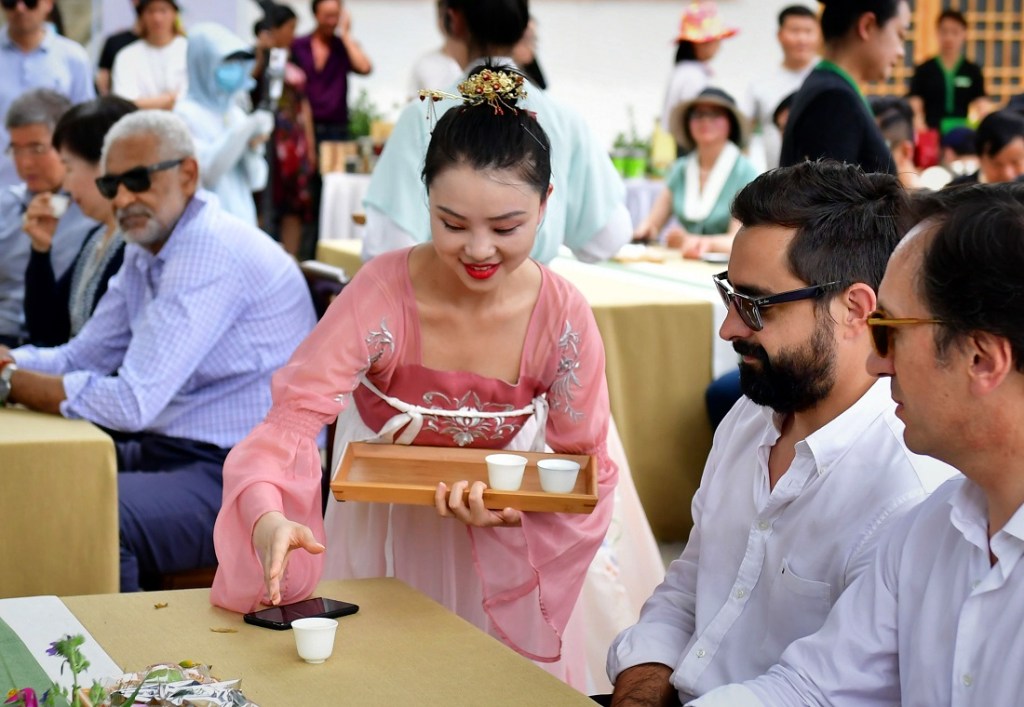
KUALA LUMPUR, June 14 (Bernama) — Diplomats and reporters from many countries recently embarked on a journey of ‘Discovering the Most Beautiful Tea Village on the Silk Road’.
They came to Shihe District, Xinyang City, Henan Province to explore the secrets of Chinese tea, according to the Shihe District Bureau of Culture, Radio & Television and Tourism, in a statement.
In the first four months of the year, three ‘China-Europe Express’ trains, loaded with Xinyang tea, travelled along the modern Silk Road to Europe and Asia.
Deputy mayor of Xinyang, Zhai Xiaobin gave a warm welcome to Chinese and foreign guests, and promoted tea exchange and cooperation.
Portuguese Ambassador to China, Jose Augusto Duarte said Portugal was the first European country to introduce Chinese tea. In the 16th century, Portuguese merchants brought Chinese tea back, and it was so expensive that only nobles could enjoy it.
Today, drinking tea is still a sophisticated lifestyle. He said the landscape was amazing, the people were beautiful, passionate, confident, and happy.
Meanwhile, Robert Quant, Ambassador of the Commonwealth of the Bahamas, who was impressed by the tea plantation said: “I will tell my friends how beautiful it is and encourage everyone to visit.”
Only lush mountains and clear rivers can produce good tea. Shihe is located on the division line of north and south, with forest coverage rate of 70 per cent.
It is in the hinterland of China, with villages dotted among the mountains and waters, displaying leisure and tranquility.
With a contiguous tea plantation of 100,000 acres, it is the origin and main producing area of Xinyang Maojian, China’s ‘Top Ten Famous Teas’.
KUALA LUMPUR, June 9 (Bernama) — To celebrate World Oceans Day, Mary Kay Inc announced that it has committed to two crucial causes in protecting the world’s waterways: the CEO Water Mandate and the United Nations Global Compact’s Sustainable Ocean Principles.
The news comes in the midst of a nationwide festival tour of the Mary Kay-produced Guardians of the Gulf, an eye-opening documentary, exploring the tumultuous relationship between the Gulf of Mexico and the conservationists determined to protect it.
Mary Kay, a global advocate for environmental consciousness and corporate responsibility in a statement said the CEO Water Mandate is a special initiative of the UN Secretary-General and the UN Global Compact, implemented in partnership with the Pacific Institute.
The Mandate mobilises a critical mass of business leaders to address global water challenges through corporate water stewardship, in partnership with the United Nations, governments, civil society organisations, and other stakeholders.
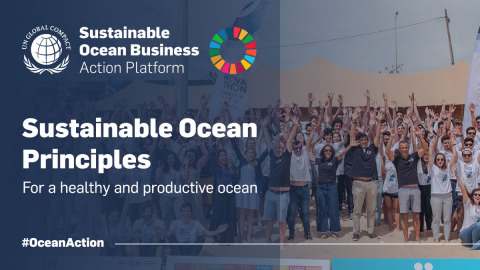
Meanwhile, the United Nations Global Compact’s Sustainable Oceans Principles, produced in consultation with over 300 stakeholders, provide a framework for responsible business practices in the Ocean across sectors and geographies.
Endorsing the Sustainable Ocean Principles is an aspirational pledge undertaken by companies of all sizes, sectors and levels of ocean stewardship maturity.
With this announcement, Mary Kay joins business leaders from worldwide in setting clear and shared expectations industry-wide for a healthy and productive ocean.
Filmed, directed and produced by an all-female crew, Guardians of the Gulf has been screened at nearly a dozen film festivals and was recently awarded two Telly Awards for Non-Broadcast General-Nature/Wildlife and Non-Broadcast General-Doc.
Mary Kay, which is set to announce its global sustainability strategy later this year, will work with the CEO Water Mandate and the United Nations Global Compact’s Sustainable Ocean Principles to further its commitment to water stewardship.

 wonderland