ZURICH, May 8 (Bernama-GLOBE NEWSWIRE) — The European Academy of Allergy & Clinical Immunology (EAACI), in partnership with the Hong Kong Institute of Allergy (HKIA), is proud to announce the inaugural EAACI Hong Kong Allergy School. This significant milestone will unfold in Hong Kong – Asia’s World City – a dynamic hub where East meets West, innovation meets tradition, and global minds converge.
Under the theme “East Meets West”, the 2025 edition of the Allergy School represents a bold step in fostering cross-continental collaboration in allergy and clinical immunology. By bringing together leading global experts, this flagship event aims to enrich knowledge exchange, advance clinical practices, and inspire innovative solutions to allergy care worldwide.
Participants will benefit from a rich, interdisciplinary scientific programme, featuring renowned international faculty and cutting-edge topics across the allergy and immunology spectrum. A special dedicated Chinese-language track will be available, promoting inclusivity and greater accessibility for Chinese-speaking professionals.
Attendees will also present their research through oral and poster sessions, connect with industry leaders, and build lasting collaborations within the global allergy community. Prizes will be awarded to top abstracts as selected by EAACI’s international panel of experts.
In celebration of this milestone, EAACI is offering exclusive benefits:
· Discounted registration for current EAACI members · A complimentary 1-year EAACI membership for registered delegates that are not EAACI members
We invite you to submit your abstracts and take advantage of early bird registration, available now. The abstract submission deadline is 31st May 2025.
As we gather to celebrate innovation, partnership, and progress, we also invite you to experience the vibrant city of Hong Kong – its iconic skyline, diverse cuisine, and cultural richness – the perfect setting for this global exchange.
Join us in shaping the future of allergy science and care. Your participation will help build a thriving; interconnected network of professionals dedicated to better outcomes for patients everywhere.
The European Academy of Allergy and Clinical Immunology (EAACI) is the leading professional organization dedicated to excellence in allergy and immunology. Learn more at https://eaaci.org.
KUALA LUMPUR, April 30 (Bernama) — The annual Cheung Chau Bun Festival, one of Hong Kong’s most iconic cultural celebrations, is set to return on May 5 to 6, marking the beginning of a packed spring of traditional festivals, arts showcases, and international sporting events across the city.
Held on the island of Cheung Chau, the festival is steeped in history and folklore, honouring Pak Tai, a sea deity believed to have saved the island from a plague in the 18th century.
According to the Hong Kong Tourism Board in a statement, since 2011, it has been recognised on China’s national list of intangible cultural heritage.
Among the highlights of this year’s programme are the Climbing Carnival on April 27, featuring games and performances; the vibrant Piu Sik Parade on May 5, where children dressed as deities and public figures appear to float above the crowd; and the adrenaline-pumping Bun-Scrambling Competition, which takes place at midnight on May 5 to 6, where climbers race up a 14-metre tower to collect the most lucky buns.
In conjunction with Labour Day Golden Week (May 1 to 5), the city will also host a 12-minute drone light show set to music along the Wan Chai Temporary Promenade on May 1, offering a dazzling display framed by Hong Kong’s iconic skyline.
The festival forms part of Cultural Beat, a citywide initiative celebrating Hong Kong’s unique cultural heritage. Other major events include the Buddha Bathing Ceremony at Po Lin Monastery (April 29 to May 5), the Tam Kung Festival in Eastern District (April 29 to May 7), and the Hong Kong International Dragon Boat Races (June 7 to 8).
Art and culture enthusiasts can also look forward to the Affordable Art Fair Hong Kong (May 22 to 25), the French May Arts Festival (ongoing until July 13), and the Chinese Culture Festival (June to September).
New highlights this year include Cirque du Soleil’s KOOZA (from May 21) and the Picasso for Asia—A Conversation exhibition at M+, featuring over 60 works by the legendary artist.
Sports fans will not be left out, with the Volleyball Nations League Hong Kong 2025 taking place from June 18 to 22, bringing together six top international teams in a high-energy tournament.
With a diverse lineup of celebrations throughout the season, Hong Kong invites residents and visitors alike to experience its rich blend of tradition and modernity.
KUALA LUMPUR, April 29 (Bernama) — China has received its first batch of imported fresh coconuts from Indonesia, with 200 kilogrammes of the tropical fruit arriving recently at Fuzhou Airport.
The delivery was quickly transferred to a processing facility within the Fuzhou Yuanhong Investment Zone—part of the “Two Countries, Twin Parks” initiative, a bilateral industrial collaboration between China and Indonesia.
According to a statement, the coconuts were subsequently delivered to a Chinese facility operating under the “Two Countries, Twin Parks” initiative, a bilateral industrial collaboration between China and Indonesia aimed at boosting synergy through shared industrial zones.
On the Chinese side, the initiative is anchored by the Fuzhou Yuanhong Investment Zone, covering 61 square kilometres, while Indonesia’s contribution spans three locations, namely Bintan, Aviarna, and Batang, with a combined area of 87.6 square kilometres.
As one of the world’s leading coconut producers, Indonesia is well-positioned to meet the strong demand for fresh coconuts among Chinese consumers, a factor that signals promising prospects for the trade.
To capitalise on the opportunity, the Fuzhou Yuanhong Investment Zone is developing a Coconut Industrial Park and has commenced operations of four production lines, aiming to establish a comprehensive upstream and downstream coconut industry chain. The initiative is expected to enhance China-Indonesia economic and trade cooperation significantly, it added.
Despite the geographical distance, the initiative mechanism has yielded over 70 bilateral projects to date, with total investment exceeding 93 billion Chinese yuan. The projects span five priority sectors, which are marine fisheries, tropical agriculture, light industry and textiles, machinery and electronics, and green mining. (100 Chinese yuan = RM59.58)
This year, which marks the 75th anniversary of diplomatic relations between China and Indonesia, Fuzhou plans to leverage opportunities arising from the initiative to further expand high-level international cooperation under the Belt and Road framework.
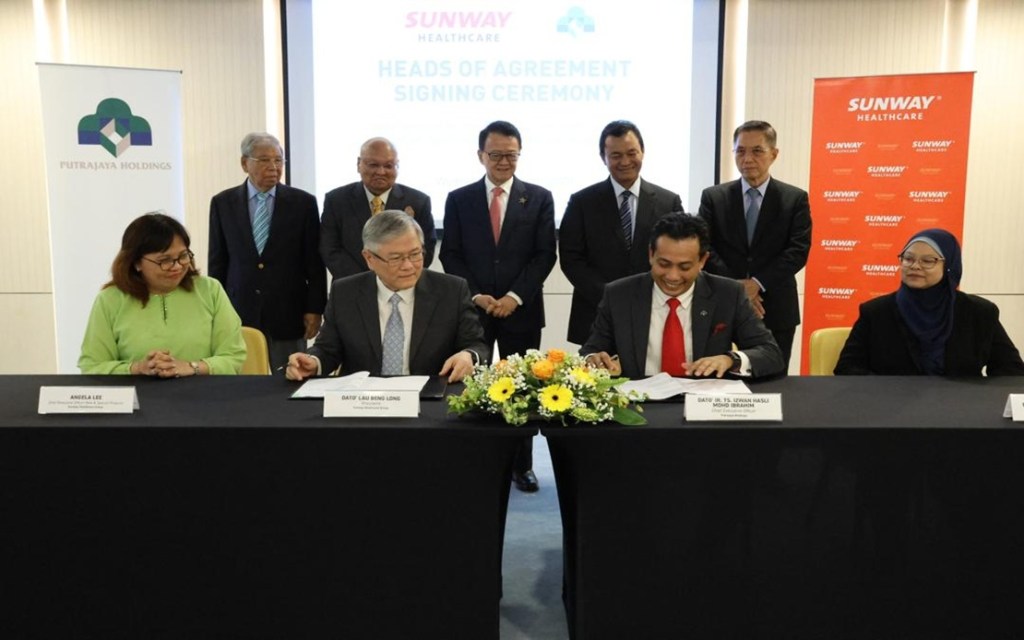
Signatories (From left to right, seated) : Ms. Angela Lee, Chief Executive Officer, New & Special Projects, Sunway Group and Dato’ Lau Beng Long, President, Sunway Healthcare Group represented Sunway Healthcare Holdings while Dato’ Ir. Ts. Izwan Hasli bin Ibrahim, Chief Executive Officer, Putrajaya Holdings Sdn Bhd and Pn Hanida Hanum bt Jamon, Senior Manager, Legal & Co. Secretarial, Putrajaya Holdings Sdn Bhd represented Putrajaya Holdings Sdn Bhd at the Heads of Agreement Signing Ceremony between Sunway Healthcare Holdings and Putrajaya Holdings Sdn Bhd Witness by (From left to right, standing) : Tan Sri Datuk Seri Razman Md. Hashim, Deputy Executive Chairman,Sunway Group Datuk Kamil Khalid Ariff, Chairman, Putrajaya Holdings Sdn Bhd Tan Sri Sir Dr. Jeffrey Cheah, Chairman, Sunway Group Datuk Sr Mohd. Salem bin Kailany, Group Chief Executive Officer, KLCC (Holdings) Sdn Bhd Tan Sri Dato’ (Dr.) Chew Chee Kin, President, Sunway Group
PUTRAJAYA, April 24 (Bernama) — Putrajaya Holdings Sdn. Bhd. (PjH) and Sunway Healthcare Holdings Sdn. Bhd. (SHH) have officially inked a Heads of Agreement (HOA) to jointly develop an integrated private medical centre in Precinct 7, Putrajaya, marking a major step forward in PjH as master-developer of Putrajaya, to develop Putrajaya as a world class city with the provision of quality and state-of-the-art healthcare services, enhancing those that are provided by the well-known Putrajaya Hospital and Institut Kanser Negara (IKN).
After months of engagement and careful planning, Precinct 7 has been identified as the ideal site, given its strategic location and accessibility, with proximity to the Putrajaya Sentral, and key health institutions like the Putrajaya Hospital, Institut Kanser Negara and Akademi Perubatan Malaysia.
A Shared Vision for Health and Well-Being
With this collaboration, PjH and SHH are setting their sights on more than just a hospital – we aim to build a modern and high quality, integrated healthcare ecosystem. The first component – the proposed medical centre is expected to house a tertiary hospital with over 300 beds, offering advanced medical services and specialist care, including a burns unit, that cater not only to Putrajaya residents but also to the wider Southern Klang Valley region as well as international patients. “PjH as the master developer provides a lifestyle oasis with our state-of-the-art infrastructure, numerous facilities, and lush and abundant open areas. The creation of a healthcare ecosystem is just another step to create a more holistic quality of life, everything you need right here in Putrajaya,” said Dato’ Ir. Ts. Izwan Hasli Mohd Ibrahim, Chief Executive Officer, Putrajaya Holdings. “This marks a catalytic milestone in Putrajaya’s growth journey, and we are excited to collaborate with a trusted partner like Sunway Healthcare to bring this shared vision to life,” he added.
Anchoring a New Urban Health District
Strategically located next to the soon-to-be-launched Destina Putrajaya – PjH’s latest commercial development slated to open in November 2025 – the proposed medical centre will benefit from seamless connectivity across Putrajaya and modern public transport links.
Destina Putrajaya, Putrajaya’s latest transportation-oriented development is designed to seamlessly integrate residential, commercial and lifestyle components with direct access to public transportation, promoting connectivity, sustainability and urban convenience.
“We are excited to partner PjH to build a medical centre in our nation’s administrative capital, enabling the Putrajaya community and beyond to access comprehensive and quality private healthcare. We are honoured that PjH has placed their trust in us and our years of experience in developing integrated healthcare facilities and networks from the ground up, including an internationally recognised flagship Sunway Medical Centre ranked as the top Malaysian hospital according to Newsweek’s World’s Best Hospitals 2025 rankings. We will strive to provide excellent facilities and compassionate, patient-centred medical care,” said Dato’ Lau Beng Long, President of Sunway Healthcare Group.
By bringing together PjH’s experience in urban development and SHH’s proven expertise in healthcare services, the collaboration is poised to elevate Putrajaya’s position as a centre for quality medical services. It marks a significant step in expanding access to specialised care and enhancing the overall healthcare landscape in the nation’s administrative capital.
ABOUT PUTRAJAYA HOLDINGS
Putrajaya Holdings Sdn. Bhd. is the master developer of Malaysia’s administrative capital of Putrajaya, the largest urban development project in the country. Putrajaya Holdings was incorporated on 19 October 1995 with the initial responsibility of designing and developing the comprehensive, highly strategic 20-year Putrajaya Masterplan.
Putrajaya Holdings is a subsidiary of KLCC (Holdings) Sdn Bhd, the master developer of the 100-acre Kuala Lumpur City Centre (KLCC) Development.
Today, with more than 20 signature development projects in Putrajaya comprising office buildings, commercial hubs, and residential, Putrajaya Holdings is an expert in the property market working alongside renowned names in the construction industry.
The winner of many prestigious sustainability awards and other cityscape awards, Putrajaya Holdings is renowned for its exemplary projects that exude modern charm, sophisticated architecture, innovation, and sustainability.
ABOUT SUNWAY HEALTHCARE GROUP
Sunway Healthcare Group (“SHG”) is one of the leading integrated private healthcare groups with an extensive network of hospitals and healthcare services in Malaysia.
The Group’s network includes its flagship quaternary hospital Sunway Medical Centre Sunway City, tertiary hospitals Sunway Medical Centre Velocity, Cheras, Sunway Medical Centre Penang, Sunway Medical Centre Damansara, and Sunway Medical Centre Ipoh, ambulatory care services at Sunway Specialist Centre Damansara, as well as complementary services at Sunway TCM Centre, Sunway Fertility Centre, and Sunway Home Healthcare. The latest addition to the Group’s offerings is Sunway Sanctuary, a senior living residence annexed to Sunway Medical Centre Sunway City.
At the heart of SHG are some of the nation’s most skilled and experienced healthcare professionals and state-of-the-art equipment, setting new benchmarks for quality medical care in the region and attracting international patients from over 170 countries.
With the aim to shape the future of healthcare, SHG has strategic collaborations in the domains of medical training, education, and clinical research with internationally renowned institutions such as the University of Cambridge, Royal Papworth Hospital, Royal College of Physicians, and Harvard Medical School.
As part of its expansion strategy to provide more communities with access to quality healthcare, SHG will increase its footprint all over Malaysia with tertiary hospitals in Iskandar Puteri (Johor), and Kota Bharu (Kelantan). With this growth, SHG will have a combined capacity of over 3,000 beds among its network of hospitals by 2030.
SOURCE: KLCC (Holdings) Sdn Bhd
FOR MORE INFORMATION, PLEASE CONTACT: PjH Strategic Communications Name: Noor Izlina Idris – Head, Business Strategy and Communications Name: Farid Emran – Head, Strategic Communications Tel: 03 8883 8888 Email: izlina@pjh.com.my Email: emran.tajuddin@pjh.com.my
Sunway Healthcare Group Group Branding, Marketing & Corp Comms Name: Lynette Lim, Chief BMC Officer Tel: +6012 3390450 Email: lynettelsc@sunway.com.my
Group Finance Director Name: Ng Chung Ren Tel: +6012 2594288 Email: ngcr@sunway.com.my
SINGAPORE, April 21 (Bernama-GLOBE NEWSWIRE) — General Omi Beef Trading Co., Ltd., a trading company specializing in Omi beef, exports Omi beef from Shiga Prefecture to Singapore through its own business and will further spread the Omi beef brand through a wholly owned subsidiary.
OMIGYU TRADING SINGAPORE PTE. LTD., a wholly owned subsidiary of General Omi Beef Trading Co., Ltd. (Head office: Moriyama City, Shiga Prefecture / CEO: Takaoki Nishino), opened its first franchise store, “STEAK SUDAKU” Telok Ayer store (3 Boon Tat St) on Monday, April 14, 2025.
[STEAK SUDAKU] “STEAK SUDAKU” is a fast-casual restaurant with Omi beef steaks as its main product, and offers quick delivery and service. The new brand name “Sudaku” has the following meaning, and is a coined word using Chinese simplified characters that is similar in sound and meaning to the Japanese word “Sudaku (gather)”.
-Xǐ: joy, enjoy -Dá: achieve -Jù: gather
The meaning behind “Sudaku”: A place where people can gather and have fun.
[Store details]
Store name: Steak Sudaku Telok Ayer Address: 3 Boon Tat St, Singapore 069612